Fabricants et fournisseurs de panneaux en bois naturel de haute qualité en Chine. Nous produisons : Panneaux acoustiques en bois Panneaux en PET
Si votre demande n'est pas traitée dans les plus brefs délais, veuillez indiquer votre adresse WhatsApp/Skype dans le message, afin que nous puissions vous contacter dès la première fois.
Nous vous répondrons dans les 24 heures. En cas d'urgence, veuillez ajouter WhatsApp/WeChat : +86-13678899682 directement.
Panneaux d'absorption acoustique reduce echo and reverberation inside a room by converting sound energy into small amounts of heat in porous material. Soundproofing blocks sound from passing through a wall, floor, or ceiling and needs mass and sealed construction. BEIEN’s PET and wood slat panels are absorbers; they do not soundproof a room.
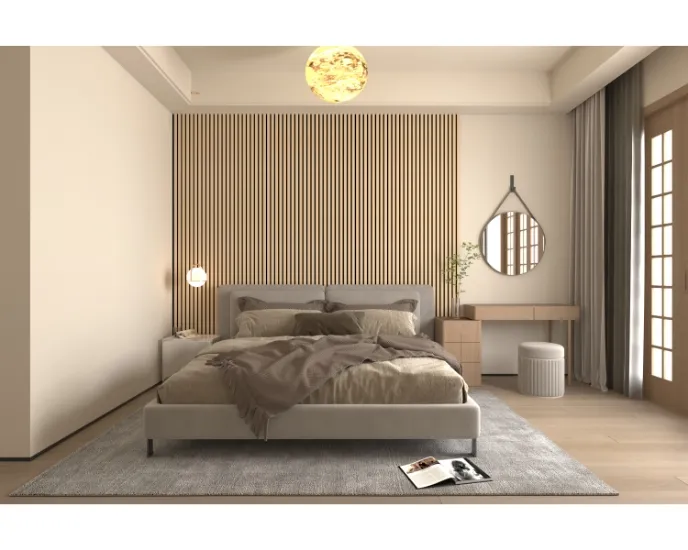
Buyers search for “panneaux acoustiques insonorisés” when they mean at least two different things. Some want a quieter meeting room, where speech is clear and nobody’s voice bounces off glass. Others want the neighbor’s music to stop coming through the wall. The first is a sound absorption problem. The second is a sound insulation problem.
Product listings blur this. A panel described as a “sound absorbing board” and one described as a “sound insulation panel” can look identical in a photo, yet they do opposite jobs. I would rather say this plainly at the start of a sales conversation than have a distributor discover it after the container arrives.
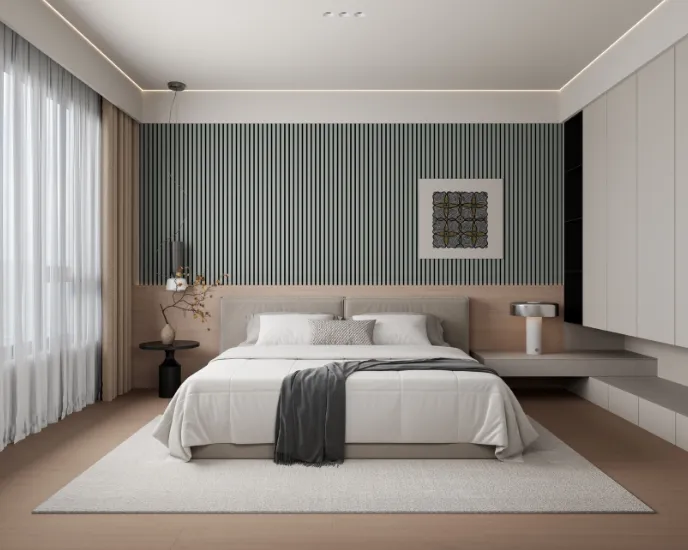
Sound hits a surface. A hard, dense surface such as glass, concrete, or painted plaster reflects most of it back into the room, which produces echo and a muddy, ringing quality. A porous or fibrous surface lets the sound wave enter the material, where friction between the air and the fibers turns part of the energy into heat. Less sound is reflected, so the room sounds drier and speech is easier to follow.
That mechanism works on sound already inside the room. A sound absorbing panel (also sold as a noise absorbing panel, sound absorption panel, or sound absorbing wall panel) does not stop sound from leaving through the wall behind it.
Sound insulation materials work differently. They resist sound transmission through a partition, and the usual levers are mass, decoupling, and airtightness. Extra layers of dense board, resilient mounting, and sealed gaps around sockets and doors all belong to this category. A thin decorative layer fixed to the room side of a wall adds almost nothing to that list.
| Factor | Panneaux d'absorption acoustique | Sound insulation constructions |
| Problem solved | Echo, reverberation, unclear speech inside the room | Noise passing between rooms or from outside |
| Mechanism | Porous or fibrous material dissipates sound energy | Mass, decoupling, and sealed joints resist transmission |
| Typical materials | PET felt, polyester fiber, mineral wool, fabric-wrapped cores | Dense board layers, resilient channels, sealants, barrier membranes |
| Where it goes | Room surfaces: walls, ceilings | Inside or across the wall, floor, or ceiling build-up |
| Main trade-off | No meaningful reduction of noise leaving the room | Heavier, more labor, usually changes the structure |
Compared with mass-based insulation builds, absorbing panels are a surface treatment you can add to an existing room. They are also the wrong tool if the complaint is noise from next door.
The most frequent one: mounting absorbers on a shared wall and expecting the neighbor to hear less. The panels may make your own room sound better, which can feel like a quieter room, but the sound crossing the wall has not changed meaningfully.
A subtler one concerns thickness and air gaps. Thin porous layers handle higher frequencies well, while low-frequency rumble such as traffic or bass needs thicker material or an air space behind it
Both product families are decorative absorbers.
Panneaux acoustiques en PET are made of 100% polyester fiber.
Wood Slat Acoustic Panels use MDF slats with a wood veneer or decorative surface and a polyester-fiber acoustic backing, which BEIEN produces in-house.
| Parameter | Panneaux acoustiques en PET | Wood Slat Acoustic Panels (BN-01 to BN-05) |
| Matériau | 100% fibre de polyester | MDF slats, wood veneer or decorative surface, polyester-fiber backing |
| Catalog dimensions | 1220 × 2420 mm; thicknesses 9, 12, 15, 24 mm | 2400, 2700, or 3000 × 605 mm; thickness 18/21 mm |
| Autres tailles | Custom sizes and thicknesses | Custom dimensions available |
| Finish range | BP-01 to BP-54 in the 2026 catalog; 40+ standard colors; Pantone or RAL matching | Wood veneer and decorative surfaces |
| Material notes | n/a | MDF density approx. 760–800 kg/m³; veneer approx. 0.4–0.5 mm; E0-grade MDF policy |
| Utilisation | Walls | Murs et plafonds |
Two documents are relevant here, and each covers less than a quick read suggests. The CE Type Examination Certificate DE/7552, issued by CSI S.p.A. against EN 15102:2007+A1:2011, describes the product “BEIEN WALL PANEL” as a decorative wall covering.
No. They reduce echo and reverberation inside the room. Blocking sound between rooms requires mass, decoupling, and sealing of the wall, floor, or ceiling construction.
Yes, and many projects do. Treat the partition for transmission first, then add absorbing panels to improve the sound quality inside the room.
Not for the wood slat or veneer families at this time. Ask for a test report matched to the exact model if your project needs absorption data.
No. That classification comes from an SGS test of a single sample (9 mm, BN-002). Other thicknesses and models need their own documentation.
By quotation, based on the factors listed above.

 French
  English
  German
  Italian
  Spanish
  Arabic
  Russian
  Dutch
Dutch