Fabricants et fournisseurs de panneaux en bois naturel de haute qualité en Chine. Nous produisons : Panneaux acoustiques en bois Panneaux en PET
Si votre demande n'est pas traitée dans les plus brefs délais, veuillez indiquer votre adresse WhatsApp/Skype dans le message, afin que nous puissions vous contacter dès la première fois.
Nous vous répondrons dans les 24 heures. En cas d'urgence, veuillez ajouter WhatsApp/WeChat : +86-13678899682 directement.
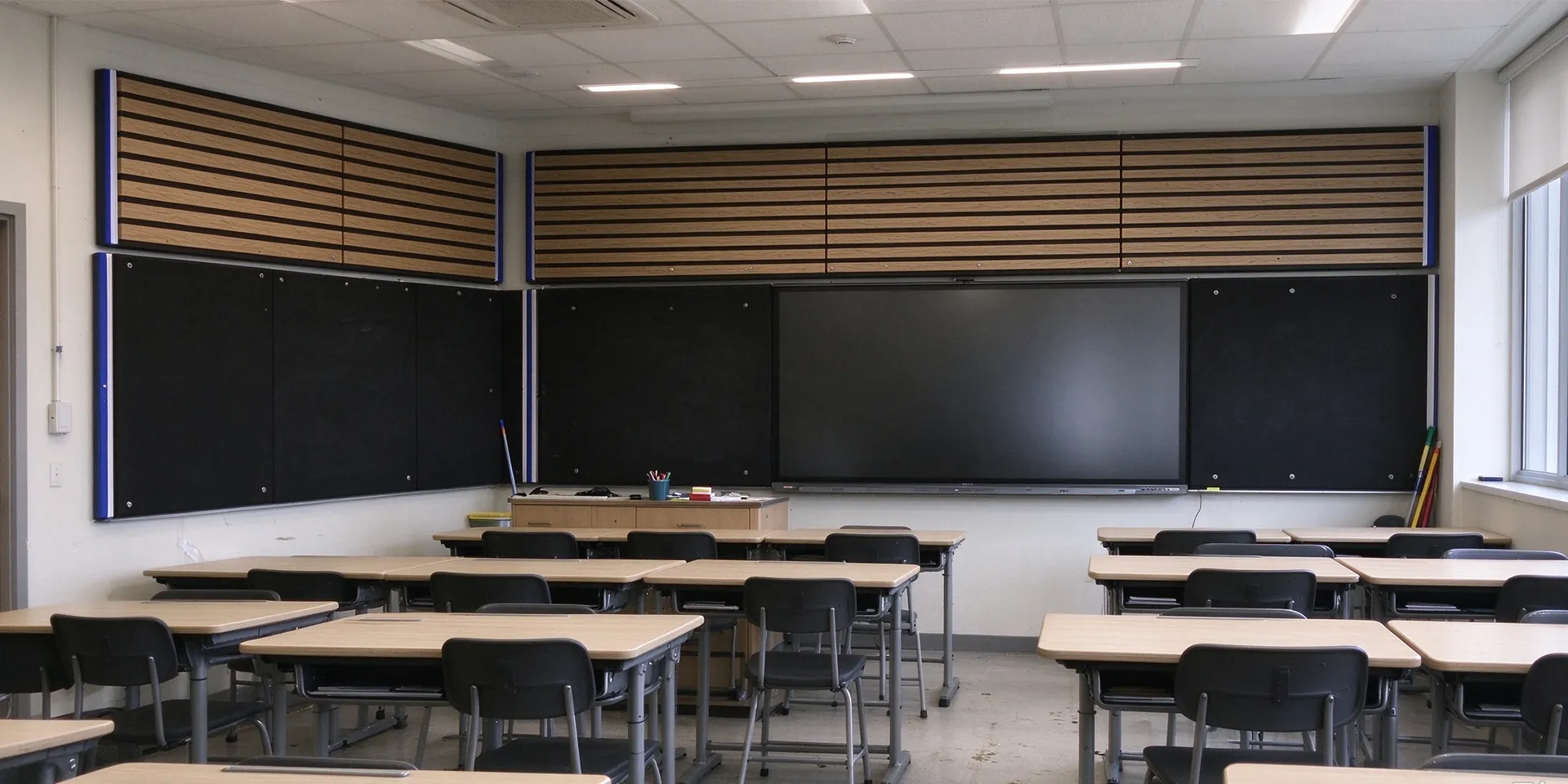
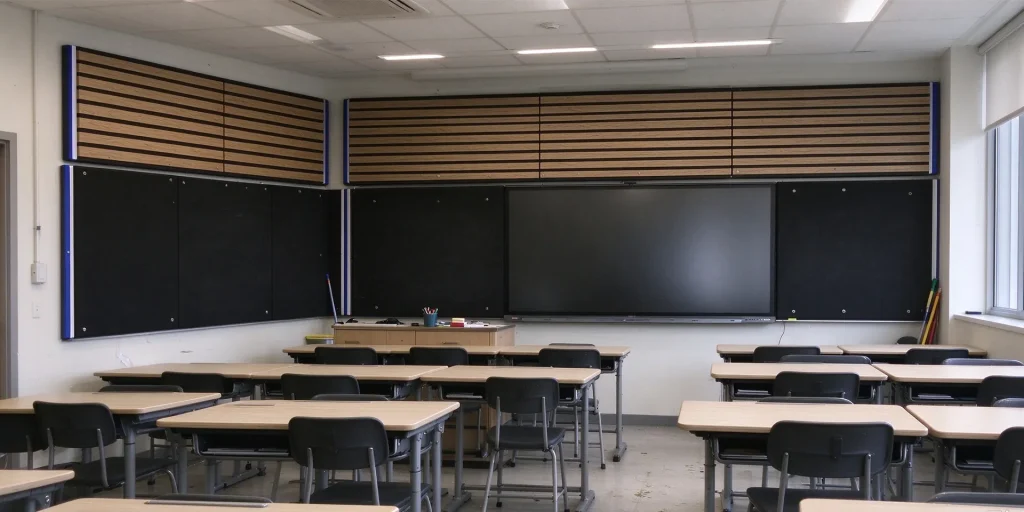
Salle de classe panneaux acoustiques are sound-absorbing wall or ceiling panels that reduce reverberation so speech stays clearer. For school buyers, the deciding questions are fire classification for the exact panel tested, material emissions, impact placement, cleaning, and documented specifications. PET felt and wood slat panels answer these questions differently.
A classroom acoustic panel is an interior finish made from a porous material, mounted on walls or ceilings. It absorbs part of the sound energy that would otherwise bounce between hard surfaces such as concrete, glass and whiteboards. Less reflected sound means shorter reverberation, so a teacher’s voice decays before it overlaps with the next syllable.
One misunderstanding comes up repeatedly. Absorption panels do not soundproof a room. They treat sound inside the classroom. Noise coming through from the corridor or the room next door depends on the wall build-up, doors and ceiling void, and a panel fixed to the surface of that wall changes very little. If the complaint is “we can hear the music room,” panels alone will disappoint.
Most school projects choose between two families:
The fire question needs a precise answer, so the details matter here.
BEIEN’s Panneaux PET are made from 100% polyester fiber. A sample of this material was tested by SGS-CSTC Standards Technical Services (Shanghai) Co., Ltd. under EN 13501-1:2018. SGS Test Report No. SHFS2403000289FF, dated 1 April 2024, records a classification of B-s2,d0. The tested configuration was:
| Tested item | Valeur |
| Sample model | BN-002 |
| Matériau | 100% fibre de polyester |
| Densité | 1700 g/m² |
| Épaisseur | 9 mm |
| Sheet size | 2420 × 1220 × 9 mm |
In EN 13501-1 terms, “B” is the reaction-to-fire class, “s2” is the smoke-production rating, and “d0” means no flaming droplets or particles were recorded.
This is the edge case that catches buyers out. The report covers this sample configuration. It does not automatically extend to 12, 15 or 24 mm sheets, to other densities, or to engraved, perforated or veneered PET products. Some suppliers list a single fire rating across an entire product range. A report tied to one specific sample is narrower, but it is also verifiable. If your project specifies 24 mm PET or a V-slot engraved panel, ask for a report that covers that configuration before you approve it.
Two further points belong in the same discussion:
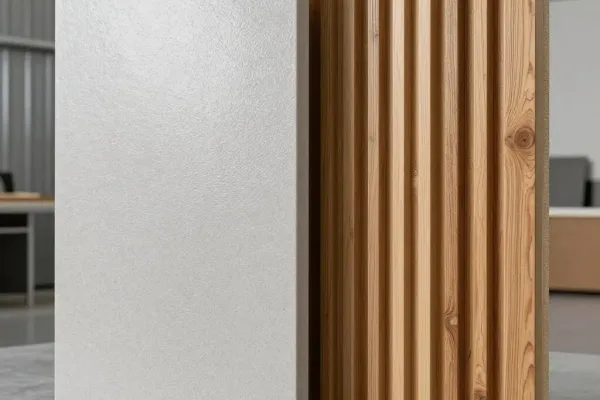
On BEIEN panneaux en lattes de bois, E0-grade is a raw-material policy for the MDF used in the slats. It describes the MDF that goes into the panel. It is not an emission test result for the finished panel, including veneer, adhesive and acoustic backing. A school buyer needs both pieces of information.
BEIEN’s published construction details for the wood slat series are:
BEIEN’s certificate page also lists an SGS formaldehyde emission test report and French VOC A+ documentation. Request the original documents, and check the tested model, test method and date against the panels you are ordering. Indoor-air requirements for schools vary by country, and a report on a different model does not answer the question.
Two certificates relate to the wood product side:
BEIEN does not currently publish impact-resistance or abrasion test data for its PET or wood slat lines. The useful answer is therefore about placement rather than a durability figure.
Divide each room into zones:
For wet or high-touch areas such as canteens, art rooms and corridors next to washrooms, BEIEN also produces a PVC-surface wood slat series (PBW-01 to PBW-06). It is described as moisture-resistant, stain-resistant and easy to clean. BEIEN has not published a separate fire classification for the PVC series, so that check applies here as well.
The replacement problem often arrives in year two, after a panel is damaged. BEIEN states a CNC cutting tolerance of ±0.3 mm, which matters when a replacement panel has to line up with a run that is already installed. Colour matching is a separate issue. Ordering a small number of spare panels with the original order is cheaper than trying to match a finish later.
| Factor | Panneaux acoustiques en PET | Panneaux acoustiques à lamelles de bois |
| Matériau de base | 100% polyester fiber felt | MDF slats on polyester-fiber backing |
| Standard size (catalog) | 1220 × 2420 mm sheets | 2400 / 2700 / 3000 × 605 mm |
| Épaisseur | 9, 12, 15, 24 mm | 18 or 21 mm |
| Surface options | 40+ standard colors (BP-01 to BP-54), Pantone/RAL matching, engraving, CNC shapes | Wood veneer, decorative surface; PVC surface in a separate series |
| Published fire classification | B-s2,d0 (EN 13501-1) for 9 mm BN-002 sample only | No product-specific classification in BEIEN’s public file |
| Material-safety documentation | Composition stated; recycled content unconfirmed | E0-grade MDF policy; CE DE/7552; FSC on request |
| Weight and handling | Light; cut on site or by CNC | Heavier (MDF at 760–800 kg/m³) |
| Typical classroom fit | Colour-coded zones, pinnable areas, shaped wall art, budget-led projects | Libraries, staff areas, auditoriums, ceilings, design-led spaces |
The trade-off for schools is fairly clear. PET gives more colour and shape freedom and has the stronger published fire documentation, but only for one tested configuration.
Panneaux acoustiques en PET
Panneaux acoustiques à lamelles de bois
Neither line currently has a published NRC value per model in BEIEN’s . If your specification includes a reverberation target, ask for test data on the exact configuration or have an acoustic consultant model the room. .
Generally no. Panels reduce echo inside the room. Sound passing between rooms is controlled by wall, door and ceiling construction.
BEIEN does not claim Class A or ASTM E84 ratings. Its documented result is EN 13501-1 B-s2,d0 for the 9 mm BN-002 sample.
Yes. More than 40 standard colours are available, along with Pantone or RAL matching, CNC-cut shapes, engraving and custom logos.
BEIEN lists its wood slat acoustic panels for wall and ceiling applications. The fixing method for overhead installation should be confirmed by the installer.
The standard lead time is stated as approximately 7–15 working days, depending on order quantity and customisation. Shipping time is additional.
No. FSC claims apply only to products and materials within the scope of certificate GFA-COC-008037 and specified as FSC for that order.

 French
 English
 German
 Italian
 Spanish
 Arabic
 Russian
 Dutch