Fabricants et fournisseurs de panneaux en bois naturel de haute qualité en Chine. Nous produisons : Panneaux acoustiques en bois Panneaux en PET
Si votre demande n'est pas traitée dans les plus brefs délais, veuillez indiquer votre adresse WhatsApp/Skype dans le message, afin que nous puissions vous contacter dès la première fois.
Nous vous répondrons dans les 24 heures. En cas d'urgence, veuillez ajouter WhatsApp/WeChat : +86-13678899682 directement.
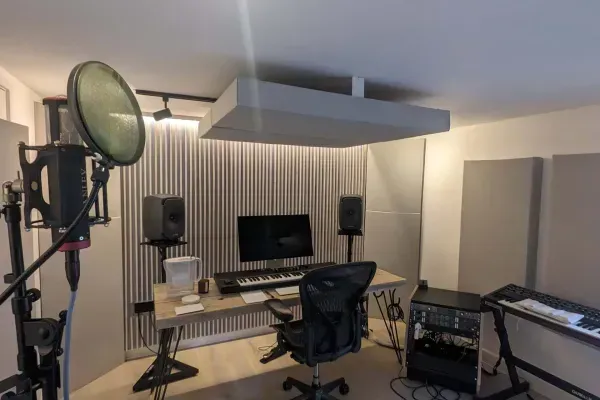
Bureau panneaux acoustiques are chosen on durability, cleanability, and documentation, not appearance alone. Wall panels below desk height take daily impact; ceiling panels must satisfy dead-load limits. The ten checks below cover material, finish, fire scope, replacement stock, and the data buyers should request before an order is confirmed.
A 400 m² open-plan floor does not need one panel specification. It needs at least two.
Specify the impact zone first, then let the remaining areas follow. Buyers who do it the other way round end up over-specifying an entire floor to protect 15% of it.
The three surface families BEIEN produces behave differently under contact, and the differences are structural rather than cosmetic.
Surface type BEIEN model reference Contact behaviour Practical office note
PET polyester fibre (exposed felt) BP-01 – BP-54 Compresses under point impact; fibre surface can pill or catch on rough objects Best above contact height, in meeting rooms, or as ceiling elements
Natural wood veneer on MDF slat NBW series Hard slat face, but veneer is approximately 0.4–0.5 mm and shows deep scratches Suits reception and executive areas with lower traffic
Technical wood veneer on MDF slat TBW-01 – TBW-11 (TBW-12 shown on the website) Same hard slat face, more consistent grain across batches Easier to match on a phased fit-out or a later reorder
PVC surface on wood slat structure PBW-01 – PBW-06 Moisture-resistant, stain-resistant, easy-clean finish The option to raise where cleaning chemicals are a known issue。
One caution on the PVC line: BEIEN’s own records show no separate product-specific certification number for the PVC surface panels. If your project requires a fire classification on the installed surface, that has to be resolved with a test on the exact configuration before the surface is written into a specification.
This is the question most often skipped, and the one that decides whether a wall still looks acceptable in year three.
A felt-faced PET panel and a veneered slat panel tolerate completely different cleaning regimes. Offices rarely clean panels the way a specification imagines; they clean them the way the existing contract already cleans everything else on that floor.
Practical approach:
Common misconception: that “sound-absorbing” and “wipeable” are compatible in the same square metre. They generally are not, because absorption depends on an open, porous surface and wipeability depends on a closed one. Slat systems solve this by putting the hard surface on the slat face and the porous material in the gaps between slats — which is why slat construction is the usual answer for offices rather than a compromise finish.
Ceiling-mounted panels introduce a dead-load calculation that wall panels do not. Structural engineers and suspended-ceiling suppliers will ask for kg/m² before they sign anything.
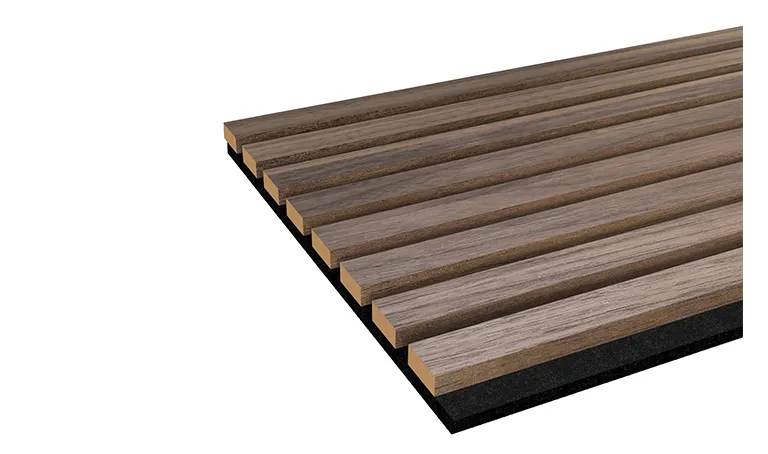
Panneaux acoustiques en lattes de bois are supplied at 2400, 2700 or 3000 × 605 mm with an 18 or 21 mm slat thickness, built from MDF at roughly 760–800 kg/m³ with a polyester-fibre backing. A per-panel weight and a finished kg/m² figure for the assembled panel are not currently published. For a wall installation this rarely blocks anything. For a ceiling, it does.
If you are specifying ceilings, request the following in writing before ordering:
Note also that the CE Type Examination Certificate DE/7552 (CSI S.p.A., EN 15102:2007+A1:2011, valid 11 June 2024 to 10 June 2029) describes the product as a decorative wall covering, model “BEIEN WALL PANEL.” Ceiling use falls outside the wording of that certificate as written, and should be confirmed with the certifying body rather than assumed.

Compared with the fabric-wrapped mineral fibre systems commonly specified in offices, slat and PET panel systems are usually chosen for appearance and installation speed as much as for absorption coefficient. That makes it more important, not less, to ask for the underlying data.
BEIEN’s published catalogue does not currently include NRC or αw values for the wood slat and wood veneer panel families. The PET Slat Panel product page shows an NRC figure of up to 0.85, but that figure sits alongside other product-page specifications that conflict with the 2026 catalogue and has not been tied to a published test report.
What this means for a buyer: if a project has a written acoustic target — a reverberation time in a school hall, a speech-privacy requirement in a clinic — that target should be handled by an acoustic consultant working from measured data on the specific build-up, not from a headline coefficient. Ask any supplier which standard was used (ASTM C423 and ISO 354 give different numbers for the same panel), what the mounting condition was, and whether an air gap was included behind the panel. An absorption figure without a mounting condition is not usable.

Offices expand, get reconfigured, and suffer damage. The panel you buy today needs to be available in eighteen months, in the same colour, in a quantity smaller than the original order.
Points to settle at quotation stage:
Schools, healthcare facilities, and enclosed meeting rooms have tighter indoor-air expectations than a warehouse office.
BEIEN operates an E0-grade material policy for wood acoustic panel raw materials, and displays French VOC A+ documentation and an SGS formaldehyde emission test report on its certificate page. The report numbers, dates, and tested sample scopes on those specific documents have not been consolidated into a single verified register yet. For a project where emissions are a written requirement, request the original documents and check four fields: tested model, test method, result, and validity date.
Two claims to avoid accepting from any supplier without paperwork: general “eco-friendly” statements, and recycled-content percentages. BEIEN’s own website carries conflicting statements on PET recycled content (100% recycled polyester, 20% recycled content, 100% polyester fibre appear in different places), which is exactly why the company’s internal rule prohibits using a recycled-content figure until it is verified per product. If recycled content is part of a tender scoring matrix, it needs a document, not a webpage.
Panel edges are where an office installation looks either finished or improvised. These decisions are cheaper to make in the factory than on site.
Edge case worth flagging: an open-plan office with a hard ceiling, glazed façade, and hard floor will not meet a speech-privacy expectation from wall panels alone, no matter how much wall area is covered. Wall panels treat first reflections at seated head height; a reverberant hard ceiling above an open plan generally needs treatment at ceiling level too. If a client has been sold “acoustic walls” as a complete solution for that room type, the expectation needs correcting before the order, not after.
Office fit-outs almost never take delivery of everything at once. Floors hand over sequentially, and site storage is limited.
BEIEN states a standard production lead time of approximately 7–15 working days depending on quantity and customisation, with export packaging and coordination for sea, air, and rail transport. Payment is typically T/T with a 30% deposit and 70% balance before shipment; EXW, FOB, CIF, and DDP terms may be discussed. Pricing is quotation-based and depends on panel type, dimensions, thickness, surface finish, fire-performance requirements, customisation level, packaging, order quantity, and shipping terms — there is no published price list, and any supplier quoting a firm price before those variables are fixed is quoting something other than your project.
For phased projects, agree three things at order stage: delivery split by phase, storage responsibility between phases, and how a damaged panel gets replaced without triggering a fresh MOQ.
| Field | Valeur |
|---|---|
| Matériau | 100% polyester fibre |
| Catalogue sheet size | 1220 × 2420 mm |
| Thicknesses | 9, 12, 15, 24 mm |
| Colour references | BP-01 – BP-54 (40+ standard colours; Pantone / RAL matching available) |
| Customisation | Size, thickness, CNC-cut shapes, engraving, private-label packaging, custom logo |
| Fire report on file | SHFS2403000289FF, EN 13501-1:2018, B-s2,d0 — tested sample BN-002 only, 9 mm, 2420 × 1220 mm |
Dimension conflict to note: certain BEIEN product pages state 1220 × 2440 mm rather than the catalogue’s 1220 × 2420 mm. Confirm the sheet dimension against the current production drawing before it enters a cutting schedule or a tender document.
| Field | Valeur |
|---|---|
| Profile models | BN-01, BN-02, BN-03, BN-04, BN-05 |
| Sizes | 2400 / 2700 / 3000 × 605 × 18 or 21 mm; other sizes available by customisation |
| Construction | MDF slats, wood veneer or decorative surface, polyester-fibre acoustic backing |
| MDF density | Approximately 760–800 kg/m³ |
| Veneer thickness | Approximately 0.4–0.5 mm |
| Material policy | E0-grade MDF |
| Applications stated | Murs et plafonds |
| Timber certification | FSC Chain of Custody GFA-COC-008037 (GFA Certification GmbH, FSC-STD-40-004 v3.1, 29 Oct 2024 – 28 Oct 2029), applicable within the certified scope only |
A: They solve different parts of the problem. PET sheets and PET elements work well above contact height and as ceiling or baffle elements. Wood slat panels give a hard, wipeable slat face at desk and shoulder height with the porous material set back in the slat gaps, which is why they are more commonly specified for walls in circulation areas.
A: BEIEN holds SGS report SHFS2403000289FF, classifying a 9 mm polyester sound-absorbing board (sample BN-002) as B-s2,d0 under EN 13501-1:2018. That classification applies to that tested configuration. For any other thickness, surface, or panel type, request the report covering that specific configuration rather than assuming the classification carries over.
A: Wood slat acoustic panels are stated as suitable for walls and ceilings. Before a ceiling installation, request per-panel weight and kg/m², substructure spacing, fixing withdrawal capacity, and a fire test report applicable to the ceiling assembly. Also note that CE certificate DE/7552 describes a decorative wall covering, so ceiling scope should be confirmed with the certifying body.
A: BEIEN’s published information currently shows both 50 panels and 100 panels depending on the page. Confirm the MOQ for your specific product family, finish, and customisation level in writing at quotation stage, and confirm separately whether repeat orders carry the same minimum.
A: Pricing is quotation-based. It depends on panel type, dimensions, thickness, surface finish, fire-performance requirements, customisation level, packaging, order quantity, and shipping terms. There is no published price list, and a firm figure is only meaningful once those variables are fixed.
A: Approximately 7–15 working days depending on order quantity and customisation, with export packaging and sea, air, or rail transport coordination available. For phased fit-outs, agree the delivery split and storage responsibility at order stage.

 French
  English
  German
  Italian
  Spanish
  Arabic
  Russian
  Dutch
Dutch