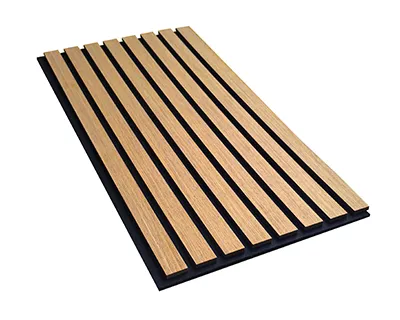
Paneles de madera natural de alta calidad Fabricantes y proveedores en China. Nosotros producto: Paneles acústicos de madera Paneles de PET
Evite que su consulta sea de respuesta tardía, por favor introduzca su WhatsApp/Skype junto con el mensaje, para que podamos ponernos en contacto con usted a la primera.
Le responderemos en un plazo de 24 horas. Si para el caso urgente, por favor agregue WhatsApp/WeChat: +86-13678899682 directamente.
“Eco-friendly acoustic panel” usually means low-VOC emissions, a recycled-content percentage, or a chain-of-custody claim on wood — three separate things suppliers frequently blend into one marketing line. Procurement teams sourcing internationally need to separate the claim from the document that proves it.
The phrase gets applied to at least three unrelated properties: the material’s recycled content, its emissions profile (formaldehyde, VOCs), and the traceability of raw wood inputs. A panel can score well on one and have no data at all on the other two. A fire-safety classification, for instance, tells you nothing about recycled content — but the two get conflated often enough in product copy that buyers assume one implies the other.
Search results for panel acústico recycled content turn up figures ranging from roughly 60% to 85%, sometimes higher, most of them presented without a linked test report or a definition of what’s being measured. That’s the core problem: “recycled content” can mean post-consumer recycled polyester, pre-consumer manufacturing waste, or simply total polyester fiber content restated as if it were recycled. These are not interchangeable numbers, and a supplier quoting one without specifying which — or without a lab report attached — hasn’t actually answered the question.
Compared to that pattern, a defensible claim looks different: it names the test method, the sample tested, and the date, and it applies to a specific product model rather than “our panels” as a category.
Before accepting an eco claim from any supplier, request documentation against these four items:
| Claim Type | Document to Request | Red Flag |
|---|---|---|
| Recycled Content % | Lab report specifying pre-consumer vs. post-consumer content by product model | A percentage without a report, or a report that does not identify the tested SKU |
| Low-VOC / Formaldehyde Emission | Formaldehyde emission test report, such as an E0/E1 grade classification, identifying the issuing laboratory | “Eco-friendly materials” claimed without a specific emission grade |
| Wood Traceability | Chain-of-custody certificate number, issuing body and certificate scope specifying the covered product lines | FSC or a similar logo used on a product not covered by the certificate |
| Fire Performance | Fire classification test report linked to a specific sample material and thickness | A fire rating claimed for the entire panel line based on only one tested configuration |
Para Paneles acústicos de PET, the confirmed material fact is that the panel core is 100% polyester fiber, produced in-house, available in standard sheet sizes and more than 40 catalog colors with custom color matching on request. What isn’t yet confirmed at the product-line level is the recycled-versus-virgin fiber breakdown — internal figures for PET composition have varied across different pages, which is exactly the inconsistency this checklist is meant to catch, including in a supplier’s own materials. Until that breakdown is confirmed per model, PET Acoustic Panels should not be quoted with a specific recycled-content percentage.
Where BEIEN does hold a specific, checkable document is fire classification: a PET sample (model BN-002, 9 mm, 1220 × 2420 mm) was tested by SGS-CSTC Standards Technical Services (Shanghai) Co., Ltd. under EN 13501-1:2018 and classified B-s2,d0. That’s a fire result, not a recycled-content or emissions result, and it applies to the tested sample configuration rather than every thickness or finish in the PET line — the same scope discipline this checklist asks buyers to apply to any supplier’s claims.

Insisting on fully documented eco claims narrows your supplier shortlist and can extend quotation timelines by a cycle or two while reports get pulled together. It also gives you something to hand to your own compliance or design-spec reviewers later, which an undocumented percentage doesn’t. The trade-off is speed versus defensibility — for a single small order that’s a minor cost; for a spec that has to survive a client or building-code review, it isn’t optional.
On pricing: cost for verified-material panels is quotation-based and depends on panel type, dimensions, thickness, surface finish, fire-performance requirements, customization level, packaging, order quantity, and shipping terms — there isn’t a fixed premium figure that applies universally, so this is a request-a-quote conversation once the documentation question is settled, not before.
No. Fire classification (e.g., EN 13501-1) measures burn behavior, not recycled content or emissions. They’re separate tests and separate documents.
Only if the PET product is explicitly listed within that certificate’s scope. FSC chain-of-custody certificates apply to wood and wood-fiber materials specifically.
The first describes the material type; the second is a claim about the source of that fiber. A product can be 100% polyester without any of it being recycled — the two statements answer different questions.
If the report already exists, it should be available within the standard quotation cycle. A supplier repeatedly deferring “we’ll send it later” on an already-completed test is itself a signal worth noting.

 Spanish
  English
  French
  German
  Italian
  Arabic
  Russian
  Dutch
Dutch