Paneles de madera natural de alta calidad Fabricantes y proveedores en China. Nosotros producto: Paneles acústicos de madera Paneles de PET
Evite que su consulta sea de respuesta tardía, por favor introduzca su WhatsApp/Skype junto con el mensaje, para que podamos ponernos en contacto con usted a la primera.
Le responderemos en un plazo de 24 horas. Si para el caso urgente, por favor agregue WhatsApp/WeChat: +86-13678899682 directamente.
A conference room needs panels that cut mid-frequency echo where speech lives, match millwork or ceiling finishes, and mount without disrupting AV or lighting runs. PET, wood slat, and veneer panels each solve this differently, and the right pick depends on wall area, budget, and how much of the absorption data is actually documented.
Meeting rooms fail acoustically in a specific way: hard surfaces (glass partitions, drywall, laminate tables) reflect speech frequencies back into the room, and remote participants on a conference call hear that reflection as a wash under every voice. Fixing it usually means treating two things separately.
Wall coverage handles first-reflection points — the spots on side walls and the wall behind the speaker where sound bounces directly back to the microphone. Ceiling coverage handles reverberation buildup in rooms taller than about 2.7 m or with hard flooring. A room can need one, the other, or both, and the panel selection below is organized around which problem each type solves best.
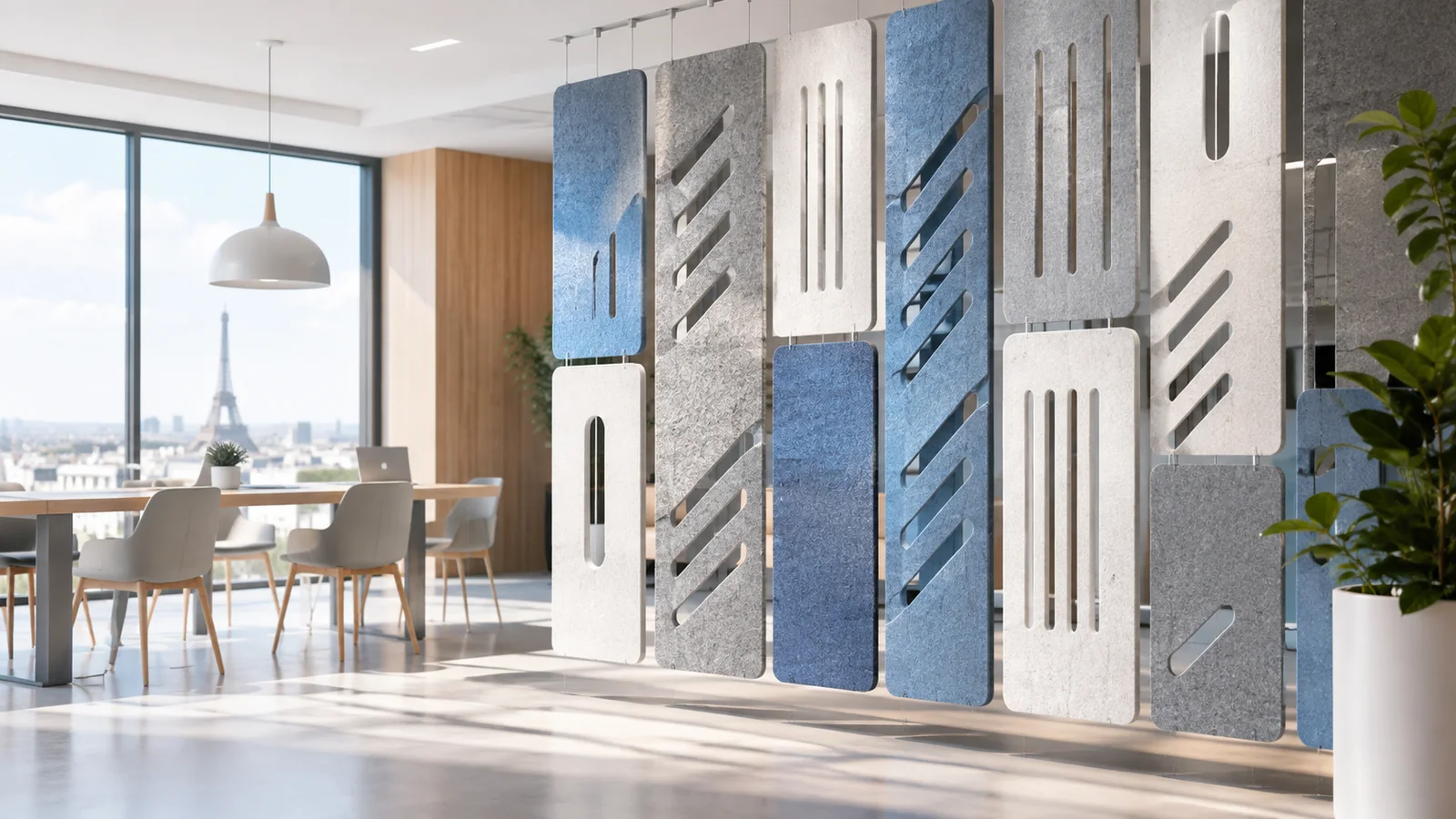
Flat PET felt sheets are the most straightforward option for covering large wall areas or acoustic partitions without a decorative finish layer. They come in 1220 × 2420 mm sheets at 9, 12, 15, or 24 mm thickness, in more than 40 standard colors (BP-01 through BP-54), with custom CNC-cut shapes available. One documented data point exists: a 9 mm, 1700 g/m² sample (model BN-002) was tested by SGS to EN 13501-1:2018 and classified B-s2,d0. That result covers the tested configuration only — it should not be quoted for other thicknesses or colors without a separate report. Note also that some product pages list the sheet size as 1220 × 2440 mm rather than 1220 × 2420 mm; confirm the current dimension before ordering.
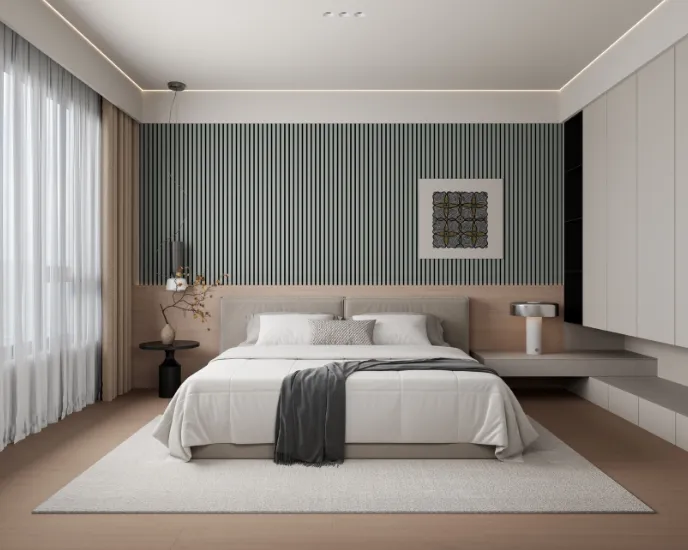
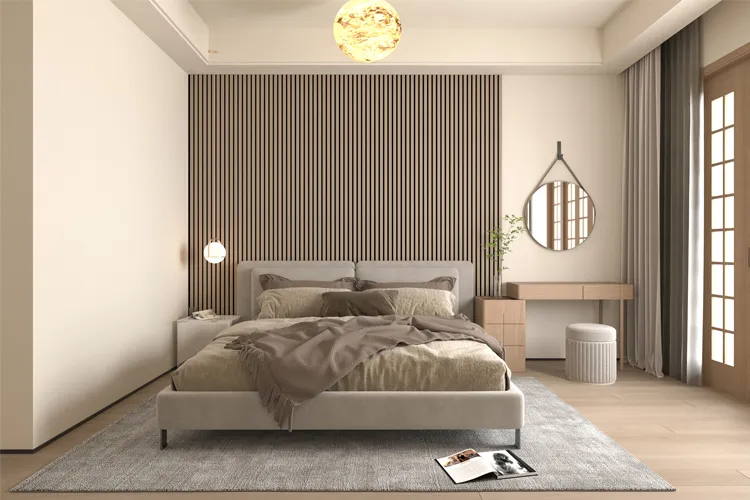
For a boardroom wall behind the presentation screen, slatted PET panels give a linear, less flat-looking surface while keeping the same felt core as the plain sheets. The 2026 catalog lists 2400/2700/3000 × 605 × 18/21 mm; separate product pages list a different configuration — 1220 × 2440 mm sheets at 6, 9, 12, or 24 mm — along with an NRC figure up to 0.85 and an optional ASTM E84 Class B or EN 13501 B-s1,d0 fire rating. No test report supporting that fire claim for the PET Slat Panel line has been identified, so it should be treated as unconfirmed until a report number is supplied, not repeated as a spec.
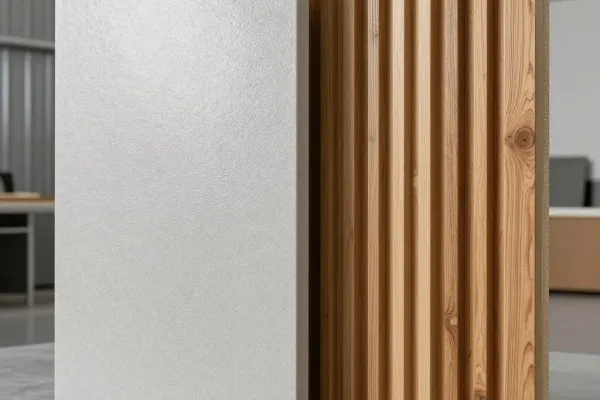
Where the room needs to read as a finished interior rather than an acoustic retrofit, the BN-01 through BN-05 wood slat profiles pair an MDF slat core (760–800 kg/m³ density) with a wood veneer face (0.4–0.5 mm) over a PET acoustic backing, in the same 2400/2700/3000 × 605 × 18/21 mm sizing as the PET slat line. MDF is E0-grade. What is missing: no published NRC or αw value for this family, and no per-panel weight figure, which matters if the panels are going on a ceiling grid rather than a wall. The FSC chain-of-custody certificate (GFA-COC-008037) covers timber sourcing for wood products in scope; the CE certificate (DE/7552) covers wall-covering use under EN 15102 — its applicability to ceiling installation has not been confirmed.
En NBW series extends the wood slat format into a wider finish range — oak, walnut, ash, teak, maple, zebra wood, and smoke oak — at a typical 21 mm thickness with lengths of 600, 2400, 2700, or 3000 mm and slat width, spacing, and felt color customizable per order. FSC-certified veneer is available for this line, but the certificate applies to the specific veneer batch it was issued for, not to every finish or order by default — worth confirming per PO rather than assuming.
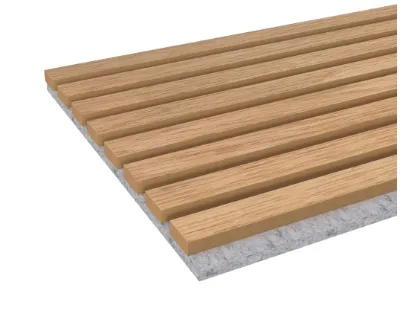
Paneles técnicos de chapa de madera-01 through TBW-12 use a technical (engineered) veneer instead of natural veneer, available in one-side or three-side coverage and finishes like classic oak, ebony, or grey oak, with black or grey felt backing. This is typically the lower-cost route to a wood-look conference room wall when full natural veneer isn’t in budget. As with the NBW line, apply a CE or FSC claim only when the specific model and material match what the certificate scope covers.
For rooms where reverberation from a hard ceiling is the bigger problem, perforated PET panels are listed for both wall and ceiling use. There is no consolidated dimension or perforation-pattern table publicly available for this line yet, so panel size, hole pattern, and open-area percentage need to be confirmed per project rather than assumed from a generic spec sheet.
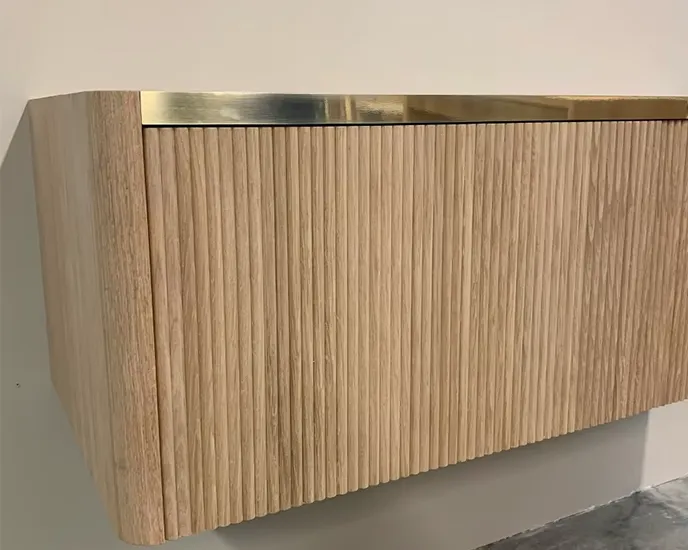
Some conference rooms, particularly ones adjoining a curved reception desk or glass-walled huddle space, use curved panels to wrap columns or follow a rounded partition. These combine a technical wood veneer face with a PET acoustic core and bend along the slat direction. No unified parameter table exists across the reviewed product pages for this line — dimensions should be confirmed by model before specifying.
Not an acoustic product on its own, but a common add-on for feature walls behind a presentation screen: LED strips sized to fit panel grooves, available in 3000K, 4000K, or 6000K, at 10 W/m and 120° beam angle, IP67-rated, 24V, in 2400 or 3000 mm lengths, with CRI ≥80. The catalog lists luminous efficiency as “≥35 lm,” which is very likely meant as lm/W rather than a flat lumen figure — that unit needs factory confirmation before it goes into a spec sheet a client will hold you to.
Why the Fire and Absorption Numbers Need a Second LookThe most common misstep in specifying panels for a commercial conference room is treating one test result as if it applies to the whole product line. BEIEN‘s only fire classification on file — B-s2,d0 under EN 13501-1:2018, from SGS-CSTC Standards Technical Services (Shanghai) Co., Ltd. — was issued for a 9 mm, 1700 g/m² polyester board sample (BN-002). It does not cover wood slat panels, other PET thicknesses, or the fire claim shown on some PET Slat Panel pages. If a building code or landlord fit-out requirement calls for a specific fire class, ask for the report number and check the tested sample against what’s actually being ordered, not the product name.
The same caution applies to absorption performance. No NRC or αw figure has been published for the wood slat family, and the NRC 0.85 figure shown on some PET Slat Panel pages conflicts with the catalog spec for that same product line. For a conference room where speech intelligibility is the actual goal, that’s a real gap — not a formality — because wall area calculations depend on it.Choosing Between Wood and PET for a Given Room
Compared to catalog-only suppliers who list a single blanket fire rating across an entire product range, a supplier that discloses which sample a fire report actually covers is giving buyers something a spec sheet alone can’t: the ability to check the claim against the order.Pricing for any of the above is quotation-based and depends on panel type, thickness, finish, fire-performance requirements, customization, packaging, and order quantity — there’s no published price list to reference here.FAQ Which panel type gives the best speech clarity in a conference room?PET acoustic sheets and slats are the more data-supported choice for absorption, since the only fire and material test on file is for a PET sample. Wood slat panels can still perform well acoustically, but no NRC figure is currently published for that line, so it can’t be quoted as a spec. Can I use the same fire rating across all panel thicknesses?No. The B-s2,d0 classification on file applies specifically to a 9 mm, 1700 g/m² PET board sample tested by SGS. A different thickness, material, or panel type needs its own report before that rating can be used. Do wood slat panels work on a ceiling as well as a wall?A: They’re offered for both, but the CE certificate on file covers wall-covering use under EN 15102; ceiling-specific applicability hasn’t been confirmed, and no per-panel weight is published yet for dead-load calculations.What’s the minimum order quantity for a single conference room?BEIEN’s published MOQ is inconsistent — 50 panels on some pages, 100 on others — so it needs to be confirmed for the specific model before ordering a small, single-room quantity.
| Tipo de panel | Material / Core | Standard Sizes | Best Use in a Conference Room | Certification Scope |
| PET Acoustic Sheets | Fibra de poliéster 100% | 1220 × 2420 mm; 9–24 mm thick | Large, flat wall or partition coverage | B-s2,d0 for the 9 mm BN-002 sample only |
| Paneles de lamas de PET | Slatted polyester felt | 2400–3000 × 605 mm (catalogue) | Textured feature walls | Fire claim unconfirmed; no report currently on file |
| Wood Slat (BN) | MDF, veneer and PET backing | 2400–3000 × 605 × 18/21 mm | Millwork-matched walls | FSC for the applicable timber scope; CE for wall coverings |
| Natural Veneer (NBW) | MDF with natural veneer | 21 mm thick; 600–3000 mm lengths | High-finish boardrooms | FSC for qualifying veneer batches |
| Technical Veneer (TBW) | MDF with engineered veneer | Model-dependent; TBW-01–TBW-12 | Cost-controlled wood appearance | CE/FSC where the selected model falls within the certification scope |
| Perforated PET | 100% PET fiber | Not yet consolidated | Ceiling clouds and baffles | Not publicly identified |
| Curved Panels | Veneer face with PET core | Not yet consolidated | Columns and curved partitions | Not publicly identified |

 Spanish
  English
  French
  German
  Italian
  Arabic
  Russian
  Dutch
Dutch