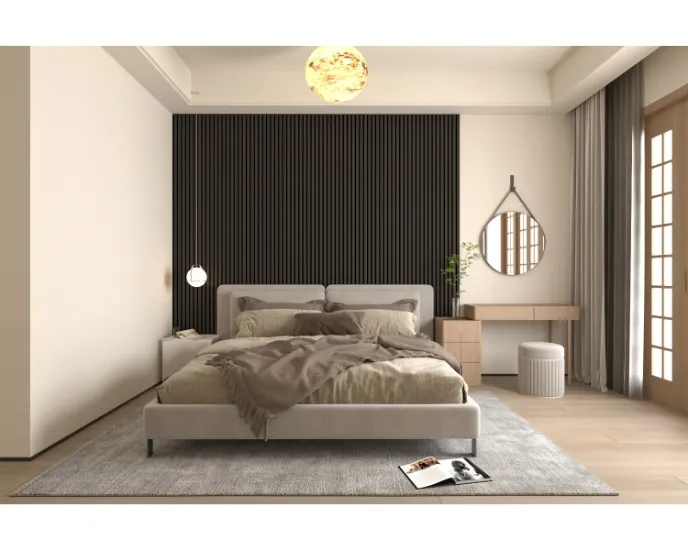
Высококачественные панели из натурального дерева производители и поставщики в Китае. Мы продукт: Дерево акустические панели ПЭТ панели
Чтобы избежать задержки ответа на ваш запрос, пожалуйста, введите ваш WhatsApp/Skype вместе с сообщением, чтобы мы могли связаться с вами в первый же раз.
Мы ответим вам в течение 24 часов. Если для срочного случая, пожалуйста, добавьте WhatsApp/WeChat: +86-13678899682 непосредственно.
Wood slats with felt backing are a layered panel: veneered MDF slats on a polyester-fiber felt backing. The slats give the surface its look; the felt does the sound absorbing. For BEIEN’s BN-01 to BN-05 series, four things can be checked on a sample: MDF density, veneer thickness, the felt backing, and the raw-material policy.
Panels sold as “wood and felt wall panels“, “slat wall panels” or “acoustic slat panels” share the same basic build. In BEIEN’s wood slat series it looks like this:
| Слой | What BEIEN states | Job in the panel |
| Поверхность | Wood veneer or decorative surface; veneer approx. 0.4–0.5 mm | Visible grain and colour |
| Slat core | MDF slats; density approx. 760–800 kg/m³; E0-grade MDF policy | Forms the slat profile (BN-01 to BN-05) |
| Backing | Polyester-fiber acoustic backing; PET felt produced in-house | Soft, porous layer that absorbs sound |
“Felt” is a trade word here. Listings use it for a nonwoven polyester-fiber sheet, not for wool. BEIEN describes its backing as polyester-fiber acoustic backing and makes the PET felt in its own factory.
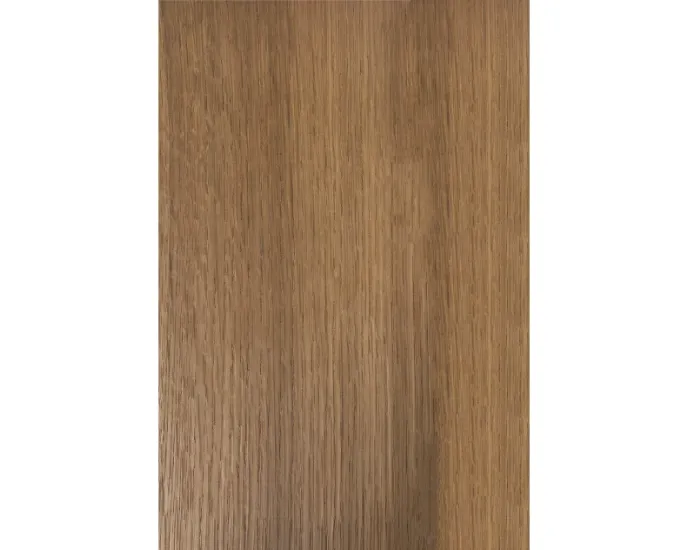
MDF density, approximately 760–800 kg/m³. This is a range, so ask which value applies to the batch you are buying, and whether it is a nominal figure or a measured one. The sample check below shows how to test a slat off-cut yourself.
Veneer, approximately 0.4–0.5 mm. Thin. It gives real grain on the face but leaves no margin for sanding, and a deep scratch or a rough site cut exposes the MDF underneath. On sites with heavy handling, order spare lengths and protect the cut ends.
E0-grade material policy. BEIEN applies an E0-grade policy to the raw materials of its wood acoustic panels. A policy governs what the factory buys; it is not an emission result for your delivery. If indoor air quality sits in your specification, ask for the original emission test report for the model and read its sample, method and date.
A backing made in the same factory. Felt production, CNC cutting (stated tolerance ±0.3 mm), automated slat pressing and panel assembly all happen in-house. Where a panel maker buys felt from outside, it can only forward the supplier’s paperwork; here, a question about the backing goes to the factory that cut and pressed the panel.
| Parameter | Stated in the 2026 catalog |
| Models | BN-01, BN-02, BN-03, BN-04, BN-05 |
| Standard sizes (L × W × T) | 2400 / 2700 / 3000 × 605 × 18 or 21 mm; other dimensions by customization |
| Ядро | MDF slats |
| Поверхность | Wood veneer or decorative surface |
| Backing | Polyester-fiber acoustic backing, produced in-house |
| MDF density | Approx. 760–800 kg/m³ (0.76–0.80 g/cm³) |
| Veneer thickness | Approx. 0.4–0.5 mm |
| Raw materials | E0-grade MDF policy |
| CNC cutting tolerance | ±0.3 mm |
| Приложения | Стены и потолки |
| Customization | OEM and ODM production with custom colours, dimensions, shapes, surfaces, labels, logos and packaging; confirm per model |
Therefore worth asking for before you specify the panel:
Thin veneer is the first cost. The second is the MDF core: like any MDF, it is sensitive to moisture, so humid spaces need a different answer. BEIEN lists a separate PVC Surface series (PBW-01 to PBW-06) with a moisture-resistant surface, which is its own product line rather than a variant of BN.
The third cost is that acoustic performance cannot be specified from the data above. With no NRC figure, an acoustic consultant working to a reverberation target will need test data for the exact slat profile and backing before approving the panel.
Against that, the construction is documented in numbers you can measure: density, veneer thickness, cutting tolerance. Compared with retail-style product pages that leave construction as scattered spec lines, a factory that states these values gives a procurement team something to check against the sample in hand.
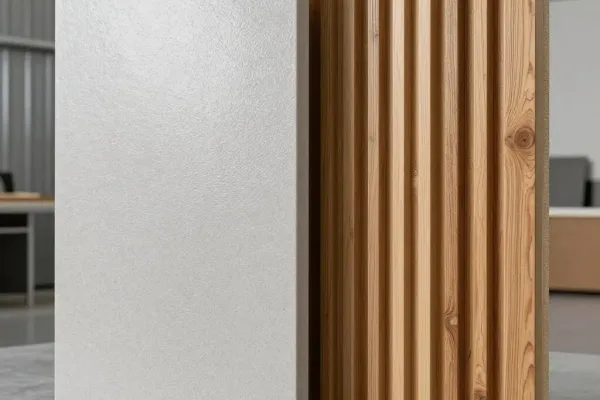
1.Measure the outside. Record length (2400, 2700 or 3000 mm), width (605 mm) and thickness (18 or 21 mm) at several points. Measure slat width and gap along the panel and compare the spread with the ±0.3 mm tolerance BEIEN states; ask BEIEN which dimensions that tolerance covers.
2.Test the density. Ask for an MDF off-cut from a slat. Measure its length, width and thickness, weigh it on a scale accurate to 0.1 g, and divide mass by volume. A result near 0.76–0.80 g/cm³ matches the stated range; because the range is approximate, a large gap is a question for the factory and a small one is not.
3.Measure the veneer. At a cut end, use calipers or a magnifier to read the veneer layer against the stated 0.4–0.5 mm. Check more than one slat.
4.Inspect the backing and the bond. Look along a cut edge for gaps between slat and felt, and press along the edge to see whether anything lifts.
5.Match paperwork to this sample. Ask for the emission test report for the model, confirmation that your order’s material sits inside the FSC scope, confirmation that the BN model is covered by DE/7552, and any absorption report that names the tested slat profile and backing. On each document, check model, date and scope.
6.Freeze the specification. Write the measured values (sizes, density, veneer thickness, backing thickness and colour) into the purchase order, so the production batch can be compared with the approved sample.
Pricing is quotation-based and depends on the panel type, dimensions, thickness, surface finish, fire-performance requirements, customization level, packaging, order quantity, and shipping terms. BEIEN’s gives a standard production lead time of about 7–15 working days, depending on order quantity and customization; reconfirm it in each quotation. MOQ is set by product and персонализация level and is confirmed at quotation.
Name the model (BN-01 to BN-05), the length, and the thickness (18 or 21 mm). Add the veneer species and finish or the decorative surface, whether the panel goes on a wall or a ceiling, and your planned quantity. If you need a custom size, label, logo or packaging, say so at this stage. Then list the documents you want back: the emission report, the certificate scope for your model, and any absorption test data. Ask for the MDF off-cut that step 2 needs, and ask for a cut-end section of the panel so the veneer and backing can be measured.
What is the felt backing on BEIEN wood slat panels made of?
BEIEN describes it as a polyester-fiber (PET) acoustic backing produced in its own factory. The recycled content of the backing has not been confirmed, so no recycled-content figure is claimed here. If you need one, ask BEIEN for the composition in writing.
Does felt backing give the panel an NRC rating?
No. Felt backing describes how the panel is built. No NRC figure for the BN series has been published, so ask for an absorption test report that identifies the tested slat profile and backing.
What MDF density and veneer thickness do the BN panels use?
BEIEN states MDF density of approximately 760–800 kg/m³ and veneer thickness of approximately 0.4–0.5 mm, with an E0-grade policy for the MDF raw material. Both numbers are approximate ranges, so measure them on your sample.
Does the SGS B-s2,d0 result apply to the wood slat panels?
Not as it stands. The report tested a 9 mm, 100% polyester sound-absorbing board labelled BN-002, and the classification applies to that sample. For the veneered MDF panel, ask for a report on that configuration.
What are the standard sizes, and can they change?
Standard sizes are 2400, 2700 or 3000 mm long, 605 mm wide and 18 or 21 mm thick. Other dimensions are available through customization.

 Russian
 English
 French
 German
 Italian
 Spanish
 Arabic
 Dutch