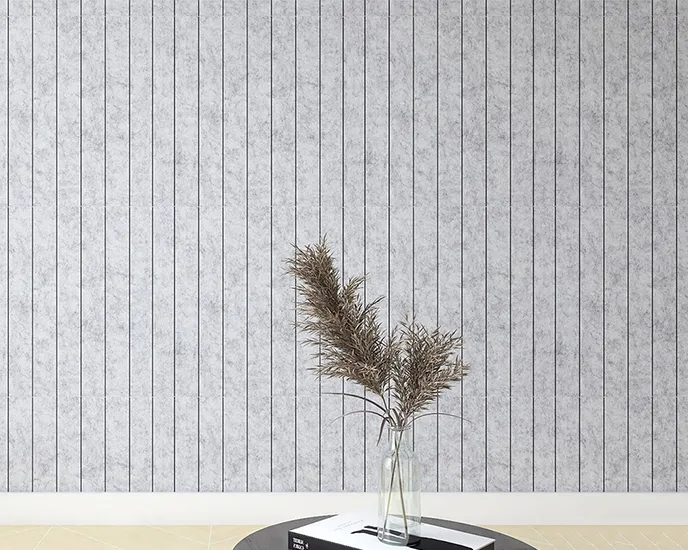
Высококачественные панели из натурального дерева производители и поставщики в Китае. Мы продукт: Дерево акустические панели ПЭТ панели
Чтобы избежать задержки ответа на ваш запрос, пожалуйста, введите ваш WhatsApp/Skype вместе с сообщением, чтобы мы могли связаться с вами в первый же раз.
Мы ответим вам в течение 24 часов. Если для срочного случая, пожалуйста, добавьте WhatsApp/WeChat: +86-13678899682 непосредственно.
Студия акустические панели are porous or slatted wall treatments that absorb mid and high-frequency reflections so a recording room sounds controlled. Thickness sets how low they work, density affects how much energy they absorb, and mounting distance shifts performance. BEIEN’s PET sheets run 9–24 mm, which suits reflection control, not deep bass trapping.
An acoustic panel takes energy out of the room by turning sound into a small amount of heat inside a porous material. That shortens reverberation and reduces flutter between parallel walls, which is what makes a vocal take or a mic’d guitar sound tighter.
It does not stop sound from leaving the room. A panel on a wall has almost no effect on what the neighbor hears. If your customer’s complaint is “the drummer is too loud next door,” that is a construction problem (mass, decoupling, sealing), and no surface panel will fix it. Getting this distinction right at the quote stage prevents returns later.
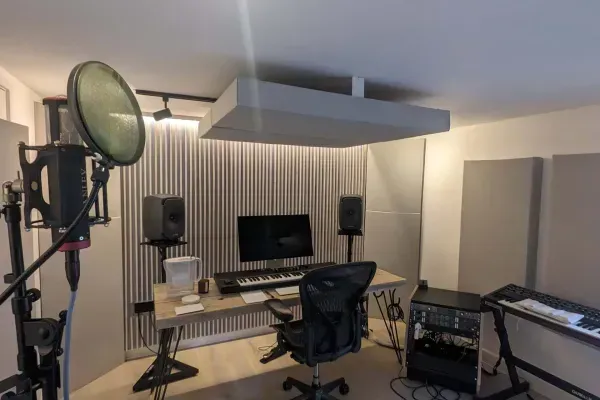
For low frequencies, thickness wins by a wide margin. A porous absorber works best where its depth is a meaningful fraction of the sound’s wavelength. A simple quarter-wavelength rule of thumb, using the speed of sound in air (about 343 m/s at 20 °C), gives the arithmetic below.
| Panel Depth (Flush on Wall) | Rule-of-Thumb Frequency Where Absorption Becomes Effective |
| 9 mm | ~9,500 Hz |
| 12 mm | ~7,100 Hz |
| 24 мм | ~3,600 Hz |
| 24 mm + 50 mm Air Gap (Illustrative) | ~1,200 Hz |
A 100 Hz kick drum or bass note has a wavelength of about 3.4 m, so a quarter of it is roughly 86 cm. A 24 mm sheet is under 3% of that.
Density is the second variable. The tested 9 mm PET sample in BEIEN’s SGS fire report is listed at 1700 g/m². Dividing by its thickness gives roughly 189 kg/m³ (again, derived by me from the report figures). Compared with the thin, light foam tiles common in generic studio roundups, this is a denser, fiber-based material with a different job: it tames reflections and keeps a room from sounding bright, and it does so with a finished surface you can specify in a design scheme.
Moving a porous panel away from the wall, or mounting it over an air gap, extends its useful range downward because the material now sits where air velocity is higher. That is why studio designers often float panels or use thicker builds behind them.
For BEIEN products, two facts limit how far you can promise this:
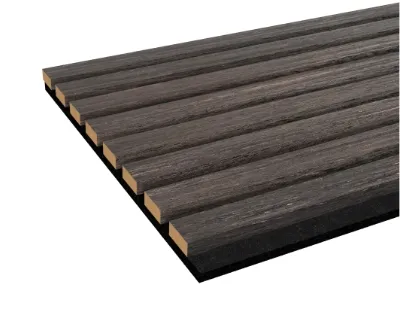
| Parameter | Акустические панели из ПЭТ | Wood Slat Acoustic Panels (BN-01 to BN-05) |
|---|---|---|
| Материал | 100% полиэфирное волокно | MDF slats, wood veneer or decorative surface, polyester-fiber acoustic backing |
| Размер | 1220 × 2420 mm (some product pages show 1220 × 2440 mm; confirm before ordering) | 2400, 2700 or 3000 × 605 mm |
| Толщина | 9, 12, 15, 24 mm | 18 or 21 mm |
| Density Data | 1700 g/m² at 9 mm (SGS sample) | MDF ~760–800 kg/m³; veneer ~0.4–0.5 mm |
| Colors and Finishes | BP-01 to BP-54; 40+ standard colors; Pantone or RAL matching | Veneer and decorative surfaces; other dimensions by customization |
| Raw-Material Policy | In-house PET felt production | E0-grade MDF policy |
| Приложение | Wall panels, custom-cut shapes, engraving | Стены и потолки |
The one third-party document on file is SGS test report SHFS2403000289FF, which classifies a 9 mm, 2420 × 1220 mm polyester sound-absorbing board (sample BN-002) as B-s2,d0 under EN 13501-1:2018. That result applies to that sample only. It does not transfer to other PET thicknesses, colors, or to wood slat panels.
Confusing absorption with isolation. Covered above, and it is the most expensive mistake.
Treating thin panels as bass traps. Even the thickest standard PET sheet here is 24 mm. It will improve clarity in the mids and highs. A room with a boomy low end needs deeper treatment, and a supplier who implies otherwise creates a callback.
Covering every wall equally. Over-absorbing a vocal booth gives a dead, fatiguing sound. Wood slat panels are often chosen for the finished look and partial coverage, so ask how much of the wall the customer actually plans to cover.
Assuming certificates follow the panel. CE certificate DE/7552 (CSI S.p.A., EN 15102:2007+A1:2011) covers the product “BEIEN WALL PANEL” as a decorative wall covering. Ceiling use is not confirmed by that document. FSC chain-of-custody certificate GFA-COC-008037 applies to timber products within its scope, and only where the order is covered.
Pricing is quotation-based and depends on panel type, dimensions, thickness, surface finish, fire-performance requirements, customization level, packaging, order quantity, and shipping terms
Thicker panels absorb lower frequencies. By the quarter-wavelength rule of thumb, a 24 mm panel flush on a wall becomes effective around 3,600 Hz; deeper treatment is needed for bass. BEIEN’s PET sheets are available at 9, 12, 15 and 24 mm.
No. Panels absorb reflections inside the room. Keeping sound from passing through walls requires mass, decoupling, and sealing.
The wood slat series is stated as available for walls and ceilings, but the CE certificate on file covers wall coverings only. Confirm ceiling scope and fire requirements for the specific project first.
Not currently. Request test data for the specific model and mounting condition before quoting acoustic performance.
No. It applies to the tested 9 mm sample, model BN-002, only.
Yes. Custom colors, sizes, thicknesses, CNC-cut shapes, engraving, labels, logos, and packaging are offered, with MOQ confirmed per product.

 Russian
  English
  French
  German
  Italian
  Spanish
  Arabic
  Dutch
Dutch