Hoogwaardige natuurlijke houten panelen fabrikanten en leveranciers in China. Wij product: Hout Akoestische panelen PET panelen
Als het antwoord op je vraag op zich laat wachten, voer dan je WhatsApp/Skype in samen met het bericht, zodat we meteen contact met je kunnen opnemen.
Je krijgt binnen 24 uur antwoord. In dringende gevallen kun je WhatsApp/WeChat toevoegen: +86-13678899682.
Hard rooms look clean, but they often sound bad. Echo builds. Speech gets muddy. Meetings feel tiring. The fix is usually not heavier construction. It is smarter acoustic treatment with the right panel in the right place.
The main use of a polyester fiber acoustic panel is to absorb reflected sound, reduce echo, improve speech clarity, and make interior spaces quieter and more comfortable. A polyester acoustic panel is commonly used on walls, ceilings, dividers, and decorative surfaces in offices, schools, hotels, studios, and other commercial and public interiors where better sound quality and flexible design both matter.

What does a polyester fiber acoustic panel actually do?
How do acoustic panels work with sound waves?
Is a polyester acoustic panel soundproof or sound absorbing?
Where is polyester fiber acoustic panel used most often?
Why do architects choose polyester fiber panels in modern acoustic design?
What are the benefits of polyester acoustic panels for B2B projects?
How does polyester compare with traditional acoustic materials?
Are polyester acoustic panels easy to install and maintain?
What should buyers check when selecting acoustic materials?
How do custom colors, shapes, and finishes improve acoustic wall design?
The core use of an acoustic panel made from polyester fiber is simple: it helps control reflected sound inside a room. Instead of letting hard surfaces bounce sound waves back and forth, the panel helps trap and dissipate part of that sound energy. This lowers reverberation, improves speech clarity, and creates a more comfortable acoustic environment. BNPANEL’s polyester acoustic panel pages describe the product as a sound absorbing solution built to reduce echo and improve room comfort in schools, offices, hotels, and cultural facilities.
That is why a polyester fiber acoustic panel is often used in places where people talk, listen, study, or work for long periods. In real projects, the goal is rarely silence. The goal is better sound quality. We use these panels to tame harsh reflections, support clearer communication, and make the room feel calmer without turning it into a heavy construction project. BNPANEL’s application page specifically highlights offices, classrooms, restaurants, theaters, and open spaces as common use areas.
To understand how acoustic panels work, think of sound as movement. When people speak, music plays, or machines run, sound waves hit walls, glass, concrete, and ceilings. In a hard room, those reflections keep bouncing. That is what creates ringing, muddiness, and long decay. A polyester acoustic panel uses a porous structure and dense fiber structure to interrupt that process and help absorb part of the reflected sound.
This is why the product is used for sound absorption rather than for stopping all sound transmission. In room acoustics, that distinction matters. Panels improve how the room sounds inside the room. They do not automatically stop sound from entering or leaving through walls.
That is one reason polyester fiber panels are now common in modern acoustic treatment instead of older one-dimensional decorative fixes.
This is one of the most important questions buyers ask. A polyester acoustic panel is mainly sound absorbing, not fully soundproof. It is designed to reduce reflected sound, manage reverberation, and support better acoustical comfort inside a room. If your project goal is lower echo and clearer speech, this is exactly what the product is meant to do.
That does not make the product less useful. In fact, for most interior jobs, the real issue is not sound from entering or leaving. The real issue is poor room response. That is why you see these panels in conference rooms, shared offices, classrooms, studios, hotel lobbies, and reception areas. The target is better sound control, cleaner communication, and a quieter and more comfortable indoor experience.
So when people ask whether these panels are for indoor sound insulation, the practical answer is this: they help with interior acoustic comfort and noise control, but they are not the same as a full wall soundproof build-up.
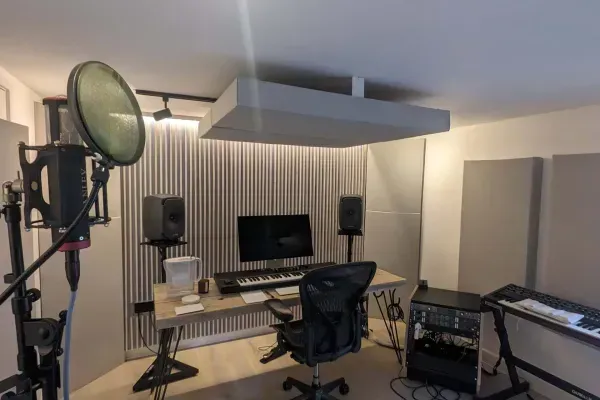
A polyester fiber acoustic panel is used in a wide variety of settings because it balances acoustic performance, appearance, and installation flexibility. BNPANEL lists offices, schools, studios, hotels, restaurants, theaters, and public buildings as core applications. The company’s case page also says it has delivered PET and wood acoustic solutions across offices, hotels, schools, and public spaces in more than 30 countries.
In practical terms, the most common use areas include:
These are all spaces where reducing echo improves how people feel and how the room functions. BNPANEL’s acoustic PET panel guide specifically discusses meeting rooms, conference spaces, and open-plan work areas where PET acoustic arrays help create quieter zones and better speech conditions.
For project browsing, acoustic panel applications and case studies are the most relevant internal pages.
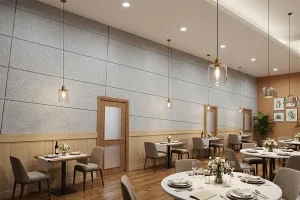
Architects and interior designers usually do not want to choose between performance and appearance. They want both. That is where polyester fiber panels perform well. BNPANEL’s product pages highlight a wide variety of colors, shapes, finishes, and decorative treatments, including plain PET felt, wood-texture surfaces, and veneer-faced options. This lets the panel act as both an acoustic wall treatment and a visual design element.
This is especially useful in modern acoustic design because large commercial and public interiors often need a material that works across many goals at once: sound absorption, fast installation, custom branding, and visual appeal. BNPANEL’s application and custom pages emphasize tailored colors, custom shapes, and OEM/ODM service for global B2B clients. That combination is a strong reason why architects specify PET acoustic products in branded workspaces, schools, hospitality interiors, and feature walls.
As a manufacturer, we see this clearly. Buyers do not only ask, “How much echo will this remove?” They also ask, “Can I match the concept board? Can I fit the schedule? Can I customize the panel for our client?” Polyester acoustic systems answer those questions better than many traditional acoustic options.
The benefits of akoestische panelen van polyester are not only technical. They are also operational. For B2B buyers, the product is attractive because it is lightweight, customizable, scalable, and relatively straightforward to install. BNPANEL describes its polyester fiber acoustic solutions as lightweight, formaldehyde-free, recyclable, and suitable for export-ready packaging and private labeling.
Here is a simple B2B view:
| Buyer need | Why polyester acoustic panel fits |
|---|---|
| Faster project delivery | panels are lightweight and eenvoudig te installeren |
| Brand differentiation | custom colors, patterns, and OEM/ODM options |
| Better occupant comfort | improved speech clarity and lower echo |
| Flexible use across sectors | works in commercial and public interiors |
| Cleaner specification path | product categories available for walls, ceilings, dividers |
These strengths matter for distributors and importers of building materials, architects, contractors, and brand owners. BNPANEL’s service positioning supports exactly this audience: custom dimensions, surface finishes, export support, and product systems designed for walls, ceilings, and decorative use.
If you want a sourcing-related internal path, aangepaste service and how to attach acoustic panels to walls are the most relevant next steps.
Compared with traditional acoustic options such as acoustic foam panels, rock wool, and other absorbing materials, polyester felt systems often win on handling, cleanliness, and finish flexibility. BNPANEL’s “felt vs foam” article says felt panels outperform foam in real testing in many cases and notes that PET felt products commonly reach strong NRC ranges across speech frequencies. It also highlights fire performance and cleaner design presentation compared with foam.
That does not mean every project should replace materials such as glass wool or mineral fiber. Those materials still have their place, especially inside hidden assemblies and batt insulation systems. But for visible interior surfaces, polyester panels often make more sense because they combine function and finish. BNPANEL’s PET product pages position the material as decorative, recyclable, and suitable for modern visible surfaces, while traditional hidden-fill materials are usually not designed for the same decorative role.
A quick comparison helps:
| Materiaal | Typische rol | Visible finish quality | Installation experience |
|---|---|---|---|
| Polyester acoustic panel | exposed surface treatment | high | simple to moderate |
| Akoestisch schuim | exposed or hidden | lower in premium interiors | simple |
| Glass wool and rock wool | usually hidden behind facings | low as exposed finish | assembly-based |
That is why many buyers now prefer polyester panels for spaces where visual appeal matters as much as acoustic treatment.
Yes. One reason this product is so popular is that it is lightweight and easy to install. BNPANEL’s installation guide says PET panels can be mounted using adhesive, Z-clip style systems, or other mounting methods depending on substrate and project needs. The company also recommends layout planning and straight cuts for cleaner results.
That matters for contractors. Less complexity usually means easier installation, fewer labor headaches, and a smoother handover. The panels are lightweight, which helps with handling on both wall panels and ceiling applications. BNPANEL’s polyester panel page also says no specialized tools are required for simple hanging systems in many applications.
Maintenance is also relatively straightforward. In most interior environments, the main job is to keep the visible surface clean and dry and avoid physical damage. For public or branded spaces, that ease of upkeep is part of the value because the system stays useful without turning into a heavy maintenance burden.

When selecting acoustic materials, buyers should look at more than color and price. Start with the acoustic target. Are you trying to reduce echo, improve speech clarity, support focused work, or add decorative treatment to a feature zone? Then check the NRC, the material build, the installation method, the finish options, and the safety documentation. BNPANEL’s articles repeatedly point buyers toward NRC, fire testing, and material type when choosing the right system.
A smart checklist includes:
This is especially important in schools, hospitality, healthcare-adjacent spaces, and other public environments. BNPANEL’s fire safety content says PET polyester fiber acoustic panels are tested to recognized standards such as ASTM E84, EN 13501, and GB 8624, and that buyers should verify the exact build and thickness for the actual tested result.
A good acoustic design should solve two problems at once: unwanted reflection and poor visual integration. Polyester felt systems are strong here because the panels are designed in many cases to work as decorative, branded, and architectural surfaces. BNPANEL’s application and product pages emphasize custom colors, patterned surfaces, wood-look finishes, and tailored layouts for different environments.
That means you can build a more acoustically effective room without relying on bulky add-ons that fight the rest of the concept. A quiet library, a branded lobby, a training room, and a creative office may all use the same base acoustic material in very different ways. One project may need soft neutral variety of colors. Another may want bold geometric baffles. Another may want a warm veneer surface that feels closer to wood than to felt.
For B2B buyers, that flexibility is not a small benefit. It is often the reason the product wins the order. When the panel can enhance the acoustic result and support the design story at the same time, it becomes more than a utility item. It becomes a project system.
A contractor fitting out an open-plan office usually faces the same pattern: hard ceiling, glass partitions, smooth wall finishes, and too much reflected speech. In that setting, adding polyester acoustic ceiling baffles, wall panels, or PET dividers can make the room easier to use without changing the full construction package. BNPANEL’s installation and applications pages point to exactly these types of open office and shared-space uses.
In our experience, this is why polyester felt panels continue to grow in demand. They solve real acoustic treatment needs, they work across a variety of settings, and they fit modern procurement logic: lighter shipping, custom finishes, easier installation, and cleaner visual results. That is a very practical acoustic solution for global B2B buyers.
What is the main use of polyester fiber acoustic panel?
Its main use is sound absorption. It helps reduce echo, control reflected sound, and improve speech clarity inside a room. It is commonly used in offices, schools, hotels, studios, and public interiors.
Is polyester acoustic panel the same as soundproof panel?
No. A polyester acoustic panel is mainly for absorbing reflected sound inside a room. It improves room acoustics, but it does not fully stop sound transmission through walls the way a true soundproof assembly does.
Do polyester fiber panels work in commercial and public buildings?
Yes. BNPANEL’s application and case pages show these panels used in offices, schools, hotels, theaters, and other commercial and public settings where better acoustics and visual finish both matter.
Are polyester fiber acoustic panels environmentally friendly?
Many PET felt systems are made with recycled PET, and BNPANEL’s PET pages describe the material as recyclable and suitable for eco-conscious interior applications. Buyers should still confirm the exact product build and certification for each project.
Are polyester acoustic panels easy to install?
Usually yes. BNPANEL’s current guides describe adhesive and clip-based mounting methods and position PET systems as lightweight products that are straightforward to handle on walls and ceilings.
How do I choose between polyester panels and rock wool systems?
Choose based on the use case. If you need a visible decorative surface with clean installation and design flexibility, polyester panels are often better. If you need hidden cavity insulation, glass wool and rock wool may still be appropriate within broader wall or ceiling assemblies.
A polyester fiber acoustic panel is mainly used to absorb reflected sound and reduce echo.
It improves speech clarity and room comfort in offices, schools, hotels, studios, and public interiors.
It is a sound absorbing product, not a full soundproof wall system.
Polyester panels are popular because they combine acoustic treatment, easy installation, and strong visual design flexibility.
For B2B buyers, customization, safety documentation, and installation method matter as much as NRC and finish.
Natural internal links work best when they stay tightly related to the article topic, so I kept them focused on PET panels, applications, installation, and customization.

 Dutch
Dutch  English
  French
  German
  Italian
  Spanish
  Arabic
  Russian