Hoogwaardige natuurlijke houten panelen fabrikanten en leveranciers in China. Wij product: Hout Akoestische panelen PET panelen
Als het antwoord op je vraag op zich laat wachten, voer dan je WhatsApp/Skype in samen met het bericht, zodat we meteen contact met je kunnen opnemen.
Je krijgt binnen 24 uur antwoord. In dringende gevallen kun je WhatsApp/WeChat toevoegen: +86-13678899682.
Decorative sound absorbing wall panels use engraved, irregular-shaped, or perforated PET as both an acoustic layer and a visual feature, rather than treating acoustics and design as separate specs. This guide separates BEIEN’s three decorative PET panel lines by construction, customization range, and the documentation currently available for each.
Product catalogs across the acoustic panel industry often group anything with a textured or shaped surface under a single “decorative acoustic panel” listing, with one shared spec sheet covering everything from a laser-cut pattern to a fully custom wave-shaped cutout. That grouping hides real differences in how the panel is made and what can be verified about it. Engraved V-slot panels, irregular-shaped panels, and perforated decorative panels start from the same 100% polyester fiber material family but diverge in fabrication method, which changes what a specifier can actually confirm before ordering.
The three lines below are treated separately here because the documentation gaps are not identical across them — lumping them together would make it harder to know which questions to ask for which product.
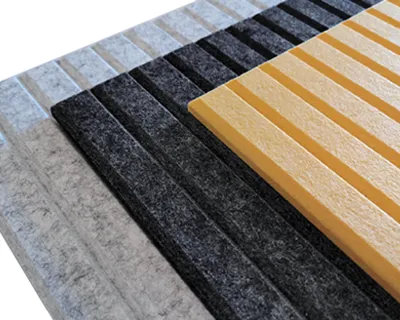
Gegraveerde V-groef PET panelen
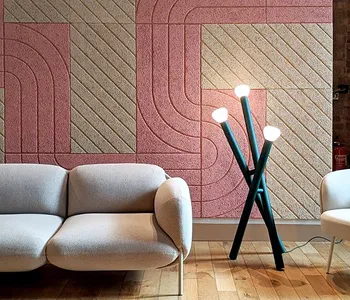
These panels use a V-shaped groove pattern cut or engraved into a PET or polyester fiber board, producing a linear or geometric surface texture rather than a flat sound-absorbing sheet.
Because the groove pattern is part of the fabrication, changing the pattern can change the effective open area and, potentially, absorption performance. That relationship isn’t quantified in any published document currently, so it has to be requested per pattern rather than assumed from a general PET panel datasheet.
Irregular PET Acoustic Panels
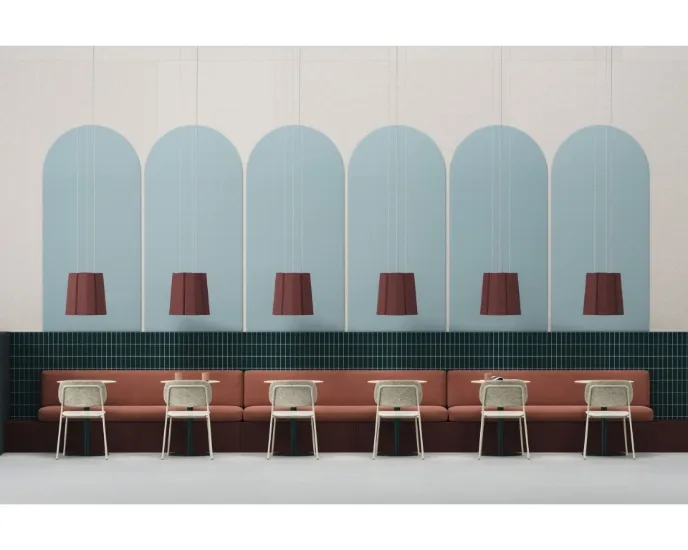
Irregular PET Acoustic Panels covers panels cut into non-standard shapes: circles, wave forms, and custom geometric outlines, aimed at wall art and decorative acoustic configurations rather than modular flat coverage.
The tradeoff with irregular shapes is coverage efficiency. A wave-cut or circular panel layout leaves more unabsorbed wall surface between units than a modular slat or square panel layout does, which matters for a project with a hard NRC target rather than a purely visual brief.
Geperforeerde PET decoratieve panelen
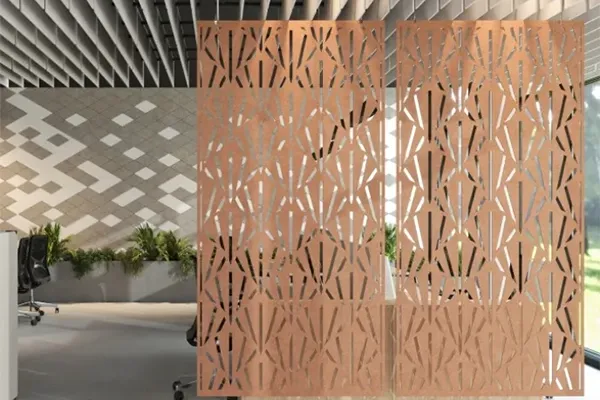
Perforated panels use a drilled or punched hole pattern across a 100% PET fiber board, intended for both wall and ceiling applications in commercial and residential interiors.
Perforation density is the variable most likely to matter to an acoustic consultant, since hole size and spacing directly affect absorption at different frequencies. That relationship isn’t documented for this line yet, which is the main reason to treat it as a request-for-data item rather than a spec to pull from a catalog page.
| Attribuut | Engraved V-Slot PET | Irregular PET | Perforated PET Decorative |
|---|---|---|---|
| Base material | 100% PET / polyester fiber | 100% polyestervezel | 100% PET fiber |
| Shape control | Fixed panel outline, custom slot pattern | Fully custom outline (wave, circular, geometric) | Fixed panel outline, custom hole pattern |
| Primary use case | Acoustic wall art, feature walls | Wall art, decorative configurations | Wall and ceiling, commercial + residential |
None of the three lines currently carries a line-specific fire test report or certificate number. That’s a gap worth naming directly rather than working around it, since a spec written around an assumed classification is a liability for whoever signs off on the project.
A frequent assumption is that because a BEIEN PET panel sample has passed a fire classification test, every PET-based product — engraved, irregular, or perforated — carries the same result. It doesn’t work that way. The SGS fire classification test on file (report SHFS2403000289FF, tested under EN 13501-1:2018 by SGS-CSTC Standards Technical Services in Shanghai) covered one specific sample: a 9mm, 1700 g/m² polyester sound-absorbing board designated BN-002, achieving a B-s2,d0 result. That result applies to the tested configuration only. It hasn’t been extended to the engraved, irregular, or perforated decorative lines, and thickness, density, or surface treatment changes are exactly the kind of variable that can change a fire classification outcome.
The same logic applies to FSC chain-of-custody certification (GFA-COC-008037), which covers wood and timber-related products — it isn’t relevant to PET-based decorative panels at all, since the certificate scope doesn’t extend to polyester fiber products.
Decorative PET panel lines make sense where the wall itself is part of the design brief — a lobby feature wall, a hospitality accent surface, a branded reception backdrop — and where acoustic performance is a secondary but present requirement. They make less sense as a primary noise-control solution in a space with a defined NRC or reverberation-time target, at least until per-model absorption data is available for the specific pattern being specified.
Compared to catalog listings that treat all textured or shaped PET panels as one interchangeable product family with a shared spec sheet, separating fabrication methods makes it clearer which documentation questions apply to which product — a pattern drawing for an engraved panel, a shape tolerance for an irregular cut, a hole-density figure for a perforated panel.
Q: Do decorative PET panels come with a published NRC rating?
A: Not for the engraved, irregular, or perforated lines specifically. No consolidated absorption data has been published for these three product families; request test data for the exact pattern and thickness under consideration.
Q: Are these panels FSC certified?
A: No. The FSC chain-of-custody certificate on file (GFA-COC-008037) covers timber-related products, not PET or polyester fiber panels.
Q: Can perforation or engraving patterns be fully custom?
A: Pattern customization is available across all three lines, but panel dimensions, hole density, and slot spacing should be confirmed per project since no single published range table covers every configuration.
Q: What fire classification do these panels carry?
A: No fire classification is currently published for the engraved, irregular, or perforated decorative lines specifically. A separate BEIEN PET sample (BN-002) holds a B-s2,d0 result under EN 13501-1:2018, but that result doesn’t transfer to a different product configuration.
Q: What’s the minimum order quantity for a custom decorative panel run?
A: MOQ is stated inconsistently across BEIEN’s own pages — 50 panels in some places, 100 in others — so it needs to be confirmed per product and customization level before a project budget is finalized.

 Dutch
Dutch  English
  French
  German
  Italian
  Spanish
  Arabic
  Russian