Hoogwaardige natuurlijke houten panelen fabrikanten en leveranciers in China. Wij product: Hout Akoestische panelen PET panelen
Als het antwoord op je vraag op zich laat wachten, voer dan je WhatsApp/Skype in samen met het bericht, zodat we meteen contact met je kunnen opnemen.
Je krijgt binnen 24 uur antwoord. In dringende gevallen kun je WhatsApp/WeChat toevoegen: +86-13678899682.
Noise complaints happen fast. A beautiful curved wall can still create harsh echo, dead spots, or loud “hot zones.” Then the space feels tiring, and the project gets blamed. The solution is not guesswork—it’s understanding how a curve moves sound, and then choosing the right acoustic treatment.
Curved walls can be good for acoustics or bad, depending on the curve shape and radius. A convex curve often helps spread sound, while a concave curved wall can focus reflections into a focal point and cause uneven sound or echo. Most projects succeed when you combine smart geometry with the right acoustic panels.
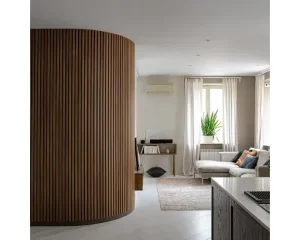
Curved wall acoustics 101: what a curve does to sound reflection
Concave curved wall vs convex curve: will the wall create a focal point?
Can a curved wall fix parallel walls and flutter echo in small spaces?
Does a curve help at every frequency, from bass to speech?
Where should speakers go near a curved wall?
How to treat a curved wall: absorption, diffusion, and smart surfaces
Using PET acoustic panels to treat a curved wall without heavy construction
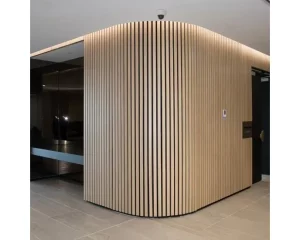
Wood acoustic panels on a curved wall: warm design with durable finishes
Corner details and radius choices: design rules that keep acoustics even
Curved wall acoustics for B2B projects: specs, samples, and OEM/ODM supply
Sound travels like a moving wave. When that sound wave hits a surface, it can reflect, be absorbed, or spread out. On a flat wall, reflection usually behaves like a mirror: the angle in equals the angle out. On a curved wall, the reflection path changes because the surface bends.
Here’s the key: a curve can either focus sound energy into a smaller area or scatter it into many directions. Researchers describe this clearly: curvature can cause diffusion when the surface is convex and focusing when it is concave.
In real project work, I tell architects and contractors to treat curved walls like “sound steering.” The curve is not decoration only—it is a tool. If you guide sound the wrong way, you may create echo. If you guide sound the right way, you can improve communication and comfort.
Not all curved surfaces behave the same. This is where many designs win or lose.
Concave: “sound magnifier”
A concave curved wall (like the inside of a bowl) can pull reflections toward one area. That area can become a focal point, where sound pressure feels stronger. This focusing effect from concave surfaces is a known issue in room acoustics and can lead to amplification and echo in certain positions.
If you ever stood in a domed chamber and noticed one spot that sounds “too loud,” you experienced this. A concave curve can behave like a sonic flashlight.
Convex: “sound spreader”
A convex curve (bulging outward) often helps spread reflections across the space, which can reduce harshness. One paper summarizes the idea well (short quote): “convex… diffusion… concave… focusing.”
Practical takeaway:
Concave curved wall: higher risk of hot spots and echo
Convex curve: often smoother, more even sound (but still needs planning)
Parallel, flat surfaces can bounce sound back and forth. That can create flutter echo and uneven response at certain distances. Many designers start with a straight wall layout and later hear the problem. Then everyone asks, “Can we add a curve?”
Sometimes, yes. A curved wall can break the “ping-pong” reflection between parallel walls by changing the reflection direction. That can reduce the feeling of repeated slap echo in some rooms.
But geometry alone rarely finishes the job. A curve can change where sound lands, but it does not guarantee comfort. You still need to treat key surfaces—especially in hard spaces like lobbies, corridors, or meeting rooms with glass and tile.
Tip from the field: If you cannot change construction, treat the surfaces you already have. A good panel plan often beats a “hopeful curve.”
No—because frequency changes how sound behaves.
Short wavelength (high frequency) sound is easier to steer and reflect in clear directions. Longer wavelength sound (like low frequencies and bass) wraps around shapes more. This is why some rooms sound okay for speech but still feel boomy.
Think of it like water waves:
Small ripples (high frequency) bounce off edges more sharply.
Big swells (low frequency) roll around objects.
So a curve may improve speech clarity in one seating area but still leave bass uneven elsewhere. The size of the room, the distance from the wall, and the curve radius all matter.
Simple rule:
If the curve is large compared to the wavelength, it acts more “mirror-like.” If it is small compared to the wavelength, the effect is softer and less predictable.
If you place a speaker close to a concave curved wall, you may aim reflections right back into the audience—or into one unlucky seat. Then people complain: “It’s loud here, but I can’t hear over there.”
I like to plan speaker layout with three checks:
Direction: where does the first strong reflection go?
Focus risk: does the curve push sound toward a focal point?
Listening positions: are there obvious “hot spots” and “dead zones”?
In many commercial spaces—like a classroom, a conference room, or a lobby—you want even sound distribution so people can communicate without strain. If the curve creates unevenness, treat the surface or adjust placement.
Quick fix approach: move the speaker angle first. Then treat the curved wall if you still hear glare or echo.
When a curved wall causes echo, you usually have two goals:
Reduce strong reflections that create harshness
Make the sound field more even so the room feels comfortable
That’s where treatment comes in. You often need to treat the curve with an absorber or a diffuser plan.
Three common strategies (simple and effective)
Absorption: remove some sound energy so reflections are weaker
Diffusion: spread reflections into many directions so they feel softer
Hybrid: absorb in key zones and diffuse in others
A curved surface can already act as a diffuser if it is convex, but treatment still helps control reverberation time and clarity.
Decision table: what to do with different curves
| Vorm | Typical behavior | Risk | Best “treat” plan |
|---|---|---|---|
| Flat wall | mirror-like reflection | flutter echo with parallel | panels on reflection points |
Convex curve |
spreads reflections | usually lower | light absorption + balanced layout |
| Concave curved wall | focuses reflections | hot spots + echo | stronger absorption + careful zoning |
Now let me speak from our daily factory work.
We are a China-based manufacturer focused on high-quality PET and wood acoustic panels for global B2B clients. When projects include a curved wall, buyers often worry about two things: can the panel follow the curve, and will it look clean after installation? That’s exactly where PET solutions shine.
PET-panelen are lightweight and installer-friendly. For many curved wall projects, you can cut, segment, and align PET panels to follow an arc without complicated framing. This reduces construction time and makes project delivery smoother.
Practical install note: a curve often looks best with smaller panel modules and clean joint planning. That helps your surface stay tight and consistent, even around a changing radius.
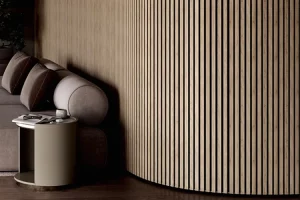
A houten lat look is popular because it feels warm and premium. In public spaces—hotels, retail, airports, museums—design matters as much as sound. A wood acoustic system can deliver both.
But wood panels on a curved wall require careful planning:
How will the slats follow the arc?
How do you hide fasteners?
How do you keep the curve smooth without visual “steps”?
For many projects, we combine wood slat fronts with acoustic backing so the wall looks beautiful while improving sound comfort. This is especially helpful in large open spaces where reflections can feel sharp.
Curves rarely live alone. They meet a corner, a ceiling, or glass. Those intersections matter.
Here are simple design rules I often share with an architect team:
Avoid creating a “bowl” aimed directly at the audience. That’s a focus trap.
Watch waterline shapes: a long concave arc can behave like a reflector.
Plan your curve radius early, not after the structure is fixed.
If you must use a concave curved wall, add treatment at the most reflective zones.
Also remember: acoustics is not only “inside the room.” Sometimes noise paths go outside the room through doors, open ceilings, or glass gaps. A good design manages both reflection and leakage.
One more practical point: curved walls can be great for wayfinding and brand style, but don’t treat them as magic. Geometry helps. Materials finish the job.
If you’re a distributor, importer, contractor, or brand owner, your real questions are usually these:
Can I get consistent quality in bulk?
Can I customize color, thickness, fire rating, and packaging?
Will the panels arrive ready for fast installation?
This is where a reliable manufacturer matters. We support customized solutions for global B2B clients—especially when the curved wall requires special module sizes, clean edge details, or specific installation methods.
Are curved walls always better than flat walls for acoustics?
No. A convex curve can spread reflections, but a concave curved wall can focus sound into a focal point and create uneven loud areas.
Why do concave curved walls cause echo?
Concave surfaces can concentrate reflected energy, which may raise sound levels at certain positions and create audible echo or coloration.
Do curved walls remove the need to treat a space?
Usually not. Curved surfaces change reflection direction, but you still often need to treat key surfaces to control echo and comfort, especially in hard commercial interiors.
What’s the easiest way to treat a curved wall?
Use modular acoustic panels (PET or wood systems) designed in smaller segments that follow the curve radius. This keeps installation clean and reduces heavy construction changes.
Can I use PET panels in public commercial projects?
Yes. PET acoustic panels are popular because they are lightweight, easy to handle, and flexible for design. For B2B projects, you should confirm project specs like thickness, color, and compliance requirements with your supplier.
How do I choose between PET and wood acoustic panels?
If you want fast installation and flexible curve coverage, PET is often a strong choice. If you want premium visuals and a warm interior style, wood acoustic panels work well—especially when paired with acoustic backing.
A curved wall is not automatically “good” for acoustics—it depends on shape and radius.
Concave curves can focus reflections and create echo hot spots.
Convex curves often help spread sound, but treatment still matters.
Geometry changes reflection path; acoustic panels control comfort.
PET and wood panel systems can be customized to follow an arc with clean module planning.
For B2B buyers, the best results come from early design coordination (curve radius + panel layout + install method).

 Dutch
Dutch  English
  French
  German
  Italian
  Spanish
  Arabic
  Russian