High-Quality Natural Wood Panels Manufacturers and Suppliers In China. We product: Wood Acoustic Panels PET Panels
Avoid your inquiry is delay response, please enter your WhatsApp/Skype along with the message, so we can contact you at the very first time.
We will reply you within 24 hours. If for urgent case, please add WhatsApp/WeChat: +86-13678899682 directly.
Big, bright rooms often sound worse than they look. Voices bounce, chairs scrape, and the ceiling becomes a giant reflector. That stress builds fast. A hanging baffle layout is a simple way to calm the space without tearing anything out.
Yes. Hanging baffles work because they add sound absorption in the air near the overhead zone, so less sound keeps bouncing around. In many open rooms, they cut the “ring,” help improve speech, and support clearer sound and communication. They won’t fully block sound between rooms, but they can quickly fix the inside-room problem.
Before we dive in, here is the promise: I will keep the ideas simple, but practical. You will learn what baffles do well, what they do not do, and how to plan a layout that feels professional to a distributor, a designer, or a project owner.
A baffle is a panel placed in the air to manage reflections. Unlike a floor rug or a wall finish, it works on both faces. In plain words, it is a soft target for sound, not a hard mirror.
A sound baffle can be a long blade, a rectangle, or a custom shape. In many commercial builds, baffles are used when the upper surfaces are hard and there is not enough soft finish. This is common in a spacious room where sound travels far and people need to talk, teach, sell, or coach all day.
From a buyer view, baffles offer a mix of function and design. Baffles represent one of the most flexible acoustic upgrades because you can add, remove, or re-space them later. That flexibility is a big part of the benefits of ceiling baffles in modern retrofits, and it is why baffles are available in many sizes and colors.

What is a sound baffle
In rooms with a high overhead deck and hard finishes, sound keeps bouncing. That long “tail” is reverberation. You notice it when you clap and the room does not stop talking back.
Here is the simple physics: the room holds sound energy after each bounce, and it takes time to fade. RT60 is a common measure of that fade. In simple terms, RT60 describes how long it takes for the level in a room to drop by about 60 dB after the sound source stops.
This matters for learning and meetings. Too much decay can hurt speech intelligibility because important speech details get masked by the leftover sound.
A sound wave leaves a person, a speaker, or a machine. The sound waves travel, and when sound waves hit a hard ceiling, they can reflect sound back into the room. This is sound reflection.
Now add hanging baffles close to that hard surface. The baffle hangs in the path of sound that has bounced. It can absorb sound waves and turn part of that energy into heat inside the fiber structure. That is why baffles are designed with porous felt, fiber cores, or perforated builds, and why many are described as designed to absorb sound.
A useful detail: baffles are suspended vertically in many layouts, which gives them two working faces and helps them intercept reflections coming from different angles. In plain language, they take some energy out of the room, so the room calms down.
“If people keep saying ‘What?’ in a nice-looking room, the room is too live. Fix the room, and the people relax.”
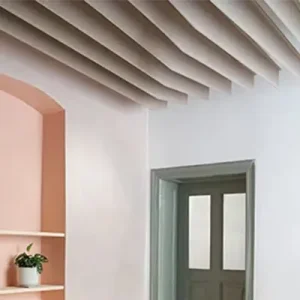
hanging baffles
Most buyers do not start with equations. They start with pain:
In these cases, baffles help because they reduce the repeated reflections that keep sound hanging in the air. This is classic acoustic treatment: you treat the room so the room stops fighting your ears.
If you have acoustical needs like better focus, calmer dining, or clearer announcements, a baffle layout can be the quickest path to improve acoustics without changing the architecture.
People often mix up two words. Echo is a clear repeat you can count. The “blur” after every sound is usually the bigger issue in offices, schools, and restaurants.
So, can they help reduce echo? Yes—hanging baffles reduce strong repeats by lowering the strength of late reflections. They also help reduce the “slap” you can get between parallel hard surfaces, so the room feels less aggressive.
We encourage clients to measure before and after. Here is a realistic pattern we see in open plan rooms (your results will vary by size and finishes):
| Space | Before (RT60) | After (RT60) | What people notice |
| Open office with hard finishes | 1.6 s | 0.9 s | calmer talk zones, better focus |
| School cafeteria | 2.0 s | 1.1 s | less shouting, clearer announcements |
| Small meeting area | 1.2 s | 0.6 s | clearer calls, less fatigue |
If you want a fast first step, consider hanging baffles in the loudest zone first, then scale the layout.
This is the most important “buyer intent” question.
Baffles do not “seal” a room. If you need soundproof isolation between rooms, you need construction: mass, airtight details, and proper assemblies.
But inside the same room, baffles can reduce noise in a useful way. They lower room decay, which lowers the “loud feel” and improves sound control. Think of it as practical noise reduction for people who work, learn, or eat in the same space.
If the goal is stop transfer to the next room, pair the baffle plan with other acoustic solutions, like better doors, wall assemblies, or a full ceiling system.
Placement decides whether baffles work well or only look nice. The goal is to intercept the main reflection paths between people, machines, and the overhead deck.
Here are placement rules we use with designers:
Most systems are hanging from the ceiling with cables. Some projects suspend from the ceiling structure using rods. Either way, keep the grid straight and the heights consistent.
Also consider what is already overhead. If you already have ceiling panels or other ceiling treatments, you may need fewer baffles than a bare concrete deck. If you need a softer look, ceiling clouds can pair well with baffles in feature zones.
One more acoustical note: put extra baffles over the places with the worst noise control problem, not over the quiet corners.
When you ask a supplier for a baffle quote, the fastest projects start with clear inputs. This also helps you avoid over-ordering or under-ordering, which is the #1 reason a room still feels loud after installation.
Here is what we suggest you include in your RFQ:
In most open spaces, acoustical baffles are a strong first layer of noise control because they intercept sound that has bounced from hard finishes. In plain language, they take the sting out of hanging sound without closing the room.
From the manufacturing side, baffles provide a nice balance: stable performance, scalable production, and easy customization. They are also easy to brand for private-label programs when you want a clean, repeatable product line.
As a professional manufacturer in China, we make both PET and wood solutions, and we support OEM/ODM sizing, colors, and branding for importers and project contractors. We also help you align the product with local codes and the visual style your market prefers.
PET felt baffles are made to be light, easy to pack, and fast to install. Wood-faced options add warmth and a premium look. In both cases, the goal is to soak up sound and avoid harsh reflections from hard surfaces.
Here is a simple buyer-friendly comparison:
| Option | Strengths | Good fits |
| PET acoustic baffle | light weight, easy color match, stable lead times | offices, schools, retail |
| Wood-faced baffle | strong visual design, pairs with timber interiors | lobbies, hospitality, brand spaces |
| Hybrid package | feature + performance areas | large mixed-use projects |
Baffles come in many shapes and thicknesses. If you want more surface area per unit, larger baffles are often the simplest upgrade.
In some rooms, panels to absorb sound on the walls are still needed. For side reflections, you can combine vertical baffles with wall-mounted baffles, or add acoustic panels near talk zones.
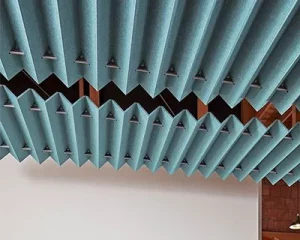
PET acoustic baffle
You do not need complex software to start. You need a clear target and a simple estimate.
A common starting point is to set a target RT60 and then add enough soft area to move the room toward that target. The main lesson is simple: bigger rooms and harder rooms need more absorbing area.
Different spaces want different “decay speed.” Below are typical planning ranges many acoustic teams use as a starting point, then fine-tune with measurement and layout tests.
| Space | RT60 goal (common) | Why it matters |
| Classroom | 0.6–0.9 s | supports speech intelligibility |
| Meeting room | ~0.4–0.8 s | clearer calls and decisions |
| Restaurant / café | ~0.8–1.2 s | lower “loud feel” |
| Gym | ~1.0–1.5 s | less harshness, better comfort |
A quick field check helps when you do not have instruments yet. Stand in the main zone, clap once, and listen. If the tail feels long and “metallic,” the room needs more absorption. Then measure after you add baffles so you can prove the result to your client.
RT60: 2.0 s |█████████████████| low sound clarity
RT60: 1.2 s |███████████ | better
RT60: 0.6 s |██████ | best sound for speech
If you are choosing between “a few pieces” and “a real system,” this chart is your friend. The goal is effective sound, not just decoration.
Most baffles can be installed without closing the space for long. That is why many contractors like them for fast retrofits.
A practical checklist:
This work does not always need special construction skills, but it does need good coordination with MEP trades.
Depending on the spec, hanging baffles might contain PET felt, fiber core with fabric wrap, or composite structures with wood finishes. Many sound baffles are designed with export packing in mind, but always confirm thickness, edge detail, and packing method for your route.
Most PET and fabric finishes clean with a soft brush or vacuum. In public areas, we recommend washable surfaces and a spare-part plan so the overall sound stays consistent over time.
Do hanging baffles work in a low ceiling room?
Yes, but you must size and place them carefully. Low rooms have less air space, so it often helps to mix baffles with ceiling panels or wall panels.
Are overhead baffles the same as ceiling sound baffles?
They are closely related. The phrase “ceiling sound baffles” usually means baffles used overhead to control reflections and room decay.
Can I combine baffles with acoustic ceiling baffles or an acoustic ceiling treatment?
Yes. A mixed system can be stronger than one method. For example, use an overhead acoustic treatment plus baffles in loud zones.
How do I know if I need baffles or wall panels?
If the biggest hard surface is overhead, start with ceiling baffles. If you also have strong side-wall reflections, add wall treatment too.
Are PET baffles safe for public projects?
They can be, but you must match fire and smoke ratings to local code. Request test reports and confirm compliance needs before ordering.
What should I send a supplier to get a fast layout proposal?
Send a room plan, photos of walls and ceilings, the room use, and a target (like “less echo” or a target RT60). We can suggest an acoustical treatment layout, sizes, and packing options for your market.

 English
  French
  German
  Italian
  Spanish
  Arabic
  Russian
  Dutch
Dutch