High-Quality Natural Wood Panels Manufacturers and Suppliers In China. We product: Wood Acoustic Panels PET Panels
Avoid your inquiry is delay response, please enter your WhatsApp/Skype along with the message, so we can contact you at the very first time.
We will reply you within 24 hours. If for urgent case, please add WhatsApp/WeChat: +86-13678899682 directly.
Open-plan rooms can feel loud, messy, and tiring because sound bounces everywhere. That echo makes speech hard to follow and meetings stressful. If you want a warmer look without the noise, decorative acoustic wood panels give you a clean design and calmer acoustics in one move.
Decorative acoustic wood slat wall panels are acoustic wall panels that combine wood slats and a sound-absorbing backing to reduce echo and improve clarity in a room. They do not magically block all noise like a concrete wall, but they absorb sound energy inside the space, which helps conversations, focus, and comfort.
When buyers say “decorative acoustic wood panels,” they usually mean a wall panel system that mixes visual rhythm with real performance. The most common style today is the wood slat look: evenly spaced slats mounted over a dark or grey felt backing. That contrast feels modern, and it also helps acoustics by giving sound more “soft surface” to hit.
In our China-based factory, we supply both PET and wood systems for B2B clients. Architects love slats because they work like a “design tool”: you can stretch them across a lobby, wrap a column, or build a decorative wall behind a reception desk. Distributors like them because one line of wood panels can serve many clients: offices, schools, studios, and retail. And brand owners like OEM because they can turn a familiar slat wall look into their own signature finish.
A quick note on wording: people use “wall paneling” and “wall cladding” loosely. In our specs, wall paneling is designed as a modular system: slats, backing, and mounting method that together deliver appearance, safety, and acoustic comfort.

Decorative acoustic wood slat wall panels
Echo happens when sound reflects off hard surfaces like glass, painted drywall, and tile. A slat system works because the backing (often felt) is porous and absorbs mid-to-high frequencies. The gaps between each slat also matter: they let sound reach the backing instead of bouncing straight back.
Here is the practical result: sound dampening inside the room. You hear less “ring,” and speech becomes clearer. That matters in meeting rooms, restaurants, and classrooms where people want to talk without raising their voices.
Now let’s ground it with data. A third-party test report on Acoustic Wood Slat Wall Panels measured NRC (Noise Reduction Coefficient) under ASTM C423 and showed performance changes based on mounting style. In that report, the same panel measured NRC 0.54 when installed directly, 0.82 with furring and additional felt, and 0.90 when combined with mineral wool behind it.
That is why we always ask contractors how they plan to mount the wall panel system before we promise a performance target.
Think of it like this: the panel face is the “style,” but the air gap and backing build the “engine.”
Let’s say it plainly: most slat systems are not soundproof products. Soundproofing means blocking sound from traveling through a wall. Slat systems mostly treat the inside of the room, so they improve the sound quality where you sit and talk.
This confusion is common because “acoustic” marketing gets sloppy online. NRC is about absorption, not blocking. If you want silence between rooms, you usually need construction changes like mass, seals, decoupling, and insulation. NRC testing (ASTM C423) focuses on how much sound a material absorbs in a space.
So what should you tell your client?
I often explain it with a simple promise: “This will dampen the harshness in the room, but it will not stop your neighbor’s bass if your wall is thin.”
Buyers usually compare three surface options:
From a project viewpoint, the biggest differences are stability, visual consistency, and budget control. A well-made veneer system can look like real wood while keeping warping low. In many commercial interiors, that stability matters more than “solid wood purity,” because clients want repeatable batches for multiple sites.
Here is a simple comparison table you can share with your team:
| Option | Best for | What you get | Watch-outs |
| Veneer over engineered core | Large rollouts, consistent color | Stable finish, clean look | Confirm scratch resistance + batch matching |
| Wood veneer over MDF | OEM lines, easy QC | Predictable machining, fast production | Ask about formaldehyde class and moisture control |
| Natural wood / timber | High-end custom builds | Authentic grain, premium feel | Higher cost, more variation, needs good sealing |
If a designer requests white oak, we can match tone and grain direction across batches, but I still recommend approving a physical sample and a “golden panel” before mass production. That single step saves weeks of arguments later.
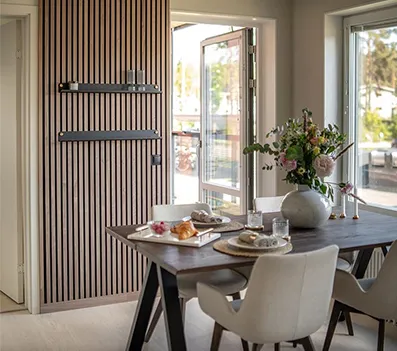
wood veneer over MDF
If you want the panel to perform well and install cleanly, the spec must cover more than color.
I suggest architects and interior design teams lock these items early:
The backing matters a lot. Many products use felt; some use PET felt made from recycled polyester fiber. Some suppliers even describe PET panels as made from 100% recycled PET fibres, and they are promoted for echo control and durability.
For wood slat systems, the combination of slats plus felt can produce strong results, and testing shows mounting style can lift NRC dramatically.
That is why we do “spec checks” with contractors: a beautiful wood wall panel that is installed wrong becomes an expensive decoration, not an acoustic solution.
One more term buyers search for: slat panels. This usually means the same product class, just a shorter name used in catalogs and distributor listings.
If you are selling to commercial spaces, the easiest wins are rooms with lots of hard finishes and lots of people talking. In my experience, the “top five” places that feel better fast are:
A simple way to plan placement is to treat the surfaces that “see” the most sound: the wall behind speakers, sidewalls near seating, and large empty walls facing glass. A single long wall panel run can do more than many small patches.
Yes, and this is where smart material choices help brand owners.
PET felt products are often marketed as recyclable and made with recycled content. Some suppliers state their PET felt contains a significant recycled portion and highlight reuse and recycling benefits.
That is why many green-building buyers like PET-based acoustic solutions: light weight, clean handling, and easy cutting onsite.
On the wood side, the “eco” story depends on sourcing and process control. You can choose stable engineered cores, reduce waste through CNC nesting, and use consistent finishes that avoid high scrap rates. You can also design a wood look that feels like luxury wood without the cost and yield loss of thick solid parts.
In our OEM programs, we often offer PET backing options such as recycled felt for brands that want a clear sustainability line. You still get the warm look of wood panels on the face, while the backing supports acoustic performance and a greener message.

Can PET and wood panels be eco-friendly and still look like luxury wood?
Distributors and importers often ask me the same question: “Should I stock standard panels or push custom?”
Here is the practical answer:
Most successful B2B lines use both. A “core SKU” list keeps inventory simple, and custom orders win big projects.
A helpful SKU strategy is:
If your buyer is a brand owner, custom branding matters too. We support private label packaging, logo stickers, barcodes, and consistent batch coding so your warehouse team can move faster.
Most complaints I hear are not about the product. They are about the last 10 percent: corners, edges, and alignment.
To achieve a seamless finish, plan these details:
In our installation guides, we keep it simple because contractors are busy: panels are designed to align quickly, and we include clear edge solutions so the result looks intentional, not patched.
This is also why the slat format is popular: it is easy to install compared to many custom carpentry walls, and it looks high-end when done right. A well-built wooden slat wall can turn a plain room into a true feature wall without weeks of onsite labor.
Before the FAQs, here is the short checklist I use with distributors, contractors, and OEM clients. It saves time and protects your margin.
If you want a simple “data story” to share with clients, use this: independent testing on a wood slat panel system showed NRC rising from 0.54 to 0.82 and 0.90 depending on installation style.
That makes a strong point: panels are engineered systems, not just décor.
For many offices and public rooms, higher is better, but install method matters. NRC is a single-number way to describe absorption in common speech frequencies, and it is commonly tied to ASTM C423 testing.
If your goal is comfort and clarity, a well-installed slat system can reach strong absorption values, especially with air gaps or insulation behind.
Many PET felt acoustic panels in the market are described as polyester-based, made from recycled material, and used to control reverberation in offices, hospitality, and schools.
For public projects, always match the local code requirements and request the right fire and emission documentation from your supplier.
A wood wall panel line usually sells on appearance and warmth, while PET sells on flexibility (shapes, colors, cut patterns) and clean handling. In practice, many projects mix both: wood slats in front-of-house zones and PET panels in meeting rooms, corridors, or ceiling features.
Yes. For OEM/ODM, we set a “golden sample,” lock the finish recipe, and run repeatable QC steps (color tolerance, dimensions, packaging drop checks). This matters most for chains and multi-site rollouts where one bad batch breaks trust.
Use wood tones to balance hard materials like glass and metal. Light oak finishes soften bright rooms, while darker slats add depth in large lobbies. For a clean look, keep the backing dark and let the slat rhythm do the work.
Ask for: material structure, finish and core details, packaging method, production lead time, warranty terms, and the exact compliance documents needed in your market. Also request a sample set and photos of previous export packaging.
If you need a single sentence for listings, here is one that buyers understand fast:
Acoustic slat wood wall panels combine decorative wood slats and a felt backing to reduce echo, upgrade wall paneling style, and support fast project installation.
If you want, I can also turn this into a distributor-ready landing page (with a short product matrix, MOQ notes, and a “Request Samples” CTA block) using your brand name and your preferred finishes.

 English
  French
  German
  Italian
  Spanish
  Arabic
  Russian
  Dutch
Dutch