High-Quality Natural Wood Panels Manufacturers and Suppliers In China. We product: Wood Acoustic Panels PET Panels
Avoid your inquiry is delay response, please enter your WhatsApp/Skype along with the message, so we can contact you at the very first time.
We will reply you within 24 hours. If for urgent case, please add WhatsApp/WeChat: +86-13678899682 directly.
Noisy rooms ruin focus, comfort, and design intent. Echo builds up, voices blur, and complaints follow. The solution is choosing the right acoustic ceiling material—one that balances sound absorption, aesthetics, safety, and budget.
The best acoustic material for a ceiling depends on the goal: controlling echo or blocking noise. For most commercial and public spaces, acoustic ceiling tiles made from PET polyester, fiberglass, or mineral fiber offer excellent sound absorption (high NRC), easy installation, and design flexibility. When sound blocking is required, acoustic tiles must be combined with ceiling soundproofing systems.
Sound absorption ≠ soundproofing: ceilings mainly absorb sound, not block it
PET polyester acoustic panels offer durability, sustainability, and design freedom
NRC ratings matter more than thickness alone
Drop ceiling systems simplify installation and maintenance
Best results come from matching material to acoustic needs and space type
OEM/ODM options reduce cost and ensure project consistency
As a professional manufacturer in China specializing in PET and wood acoustic panels, we work daily with distributors, architects, and contractors to solve real-world ceiling acoustics challenges. This guide shares what actually works—based on projects, testing data, and long-term use.

How to Choose the Right Acoustic Panels
Why does the ceilingmatter so much in room acoustics?
Acoustic vs soundproof: what’s the real difference?
What makes an acoustic ceiling tileeffective?
How does NRCdefine acoustic performance?
Which acoustic materialswork best for ceilings?
Are PET polyester acoustic panelsbetter than fiberglass?
How do ceiling systems reduce echo in commercial spaces?
What ceiling solutions fit conference rooms, studios, and offices?
Is a drop ceilingor exposed ceiling better for acoustics?
How to choose the right acoustic ceiling tilefor your project?
The ceiling is often the largest uninterrupted surface in a room. When untreated, it reflects sound waves downward, increasing reverberation and raising the overall noise level. This is why poor ceiling acoustics quickly lead to echo, speech fatigue, and discomfort.
In my experience working on offices, schools, and public buildings, improving the ceiling acoustics alone can cut perceived noise by 30–50%. That’s why ceilings play a central role in any serious acoustic treatment strategy.
This is one of the most common misunderstandings. Acoustic materials are designed to absorb sound, improving sound quality inside a room. Soundproof materials aim at sound blocking, preventing sound from passing between spaces.
Most ceiling tiles focus on sound absorption, not sound isolation. True soundproofing the ceiling requires additional layers such as drywall, mass-loaded barriers, and resilient systems. Knowing this distinction avoids unrealistic expectations.
An effective acoustic ceiling tile is engineered to disrupt and absorb sound waves instead of reflecting them. Key factors include porosity, fiber structure, and air gaps above the tile.
Modern acoustic tiles are designed to absorb mid- and high-frequency noise, helping reduce echo and improve speech clarity. In commercial spaces like offices and classrooms, this directly improves productivity and comfort.
NRC (Noise Reduction Coefficient) measures how much sound a material absorbs. Values range from 0.0 to 1.0. A tile with NRC 0.85 absorbs 85% of incoming sound energy.
For most ceilings:
NRC 0.60–0.70: basic noise control
NRC 0.75–0.85: professional acoustic control
NRC 0.90+: spaces where maximum sound absorption is required
Choosing by nrc is more reliable than choosing by thickness or weight alone.
Several soundproofing materials and acoustic products are commonly used in ceiling applications:
| Material | Acoustic Strength | Key Notes |
| PET polyester | High | Durable, eco-friendly |
| Fiberglass | Very high | Excellent absorption, fragile |
| Mineral fiber | Medium–high | Cost-effective |
| Wood acoustic panels | Medium | Aesthetic + absorption |
Among these, polyester acoustic panels are increasingly popular for projects requiring safety, sustainability, and long-term durability.
From a manufacturing and project perspective, PET panels offer several advantages. They provide excellent sound absorption, resist moisture, and don’t release fibers—making them safer for schools and healthcare buildings.
Fiberglass still delivers strong acoustic performance, but PET panels are easier to cut, install, and customize. That’s why many architects now specify PET for acoustics ceiling systems in high-traffic spaces.

PET polyester acoustic panels
In commercial spaces, uncontrolled reverberation increases background sound and reduces speech clarity. Installing ceiling soundproofing materials that absorb reflections dramatically improves communication.
We’ve seen measurable improvements in:
Open-plan offices
Airports and transit hubs
Educational facilities
Retail and hospitality interiors
A properly designed acoustic ceiling helps keep noise levels down and prevent disruption to adjacent spaces.
Different spaces require different solutions:
Conference room: high NRC ceiling tiles for speech clarity
Recording studios: acoustic panels combined with sound isolation
Home theaters / home studio: layered systems for sound control
Common offices: grid ceiling with acoustic tiles
Matching the acoustic needs of each space ensures consistent results without overspending.
A drop ceiling offers a hidden plenum that boosts absorption and allows easy maintenance. It’s the most common choice for offices and public buildings.
Exposed ceilings can work acoustically, but only when paired with suspended acoustic panels or baffles. Otherwise, sound reflects off hard surfaces, increasing reverberation.
To choose the right solution, consider:
Target NRC and room function
Ceiling height and grid compatibility
Fire rating and safety standards
Long-term durability and maintenance
Design integration
From our OEM/ODM experience, early coordination between architect, contractor, and acoustic supplier saves time and avoids costly rework.
Is an acoustic ceiling tile the same as soundproofing?
No. Acoustic tiles absorb sound inside a room but don’t block sound transmission on their own.
What NRC rating is good for offices?
An NRC of 0.75–0.85 works well for most office environments.
Are PET acoustic panels environmentally friendly?
Yes. They are often made from recycled polyester and are fully recyclable.
Can acoustic ceiling tiles improve speech clarity?
Absolutely. By reducing reverberation, they significantly improve speech intelligibility.
Do acoustic ceilings work in large public buildings?
Yes. They are widely used in airports, schools, and multipurpose spaces.
The best acoustic ceiling material depends on absorption, not just thickness
Acoustic ceiling tiles improve sound quality, not sound isolation
NRC ratings are critical when comparing materials
PET polyester panels balance performance, safety, and sustainability
Early specification ensures better results and cost control
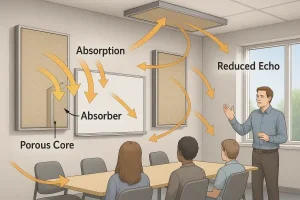
The basics of sound absorption
If you’re evaluating ceiling acoustics for a project, I recommend starting with a performance brief—not a product list. Share your space type, noise concerns, and design goals, and we’ll help you define the best acoustic ceiling solution with tested data and reliable manufacturing support.

 English
  French
  German
  Italian
  Spanish
  Arabic
  Russian
  Dutch
Dutch