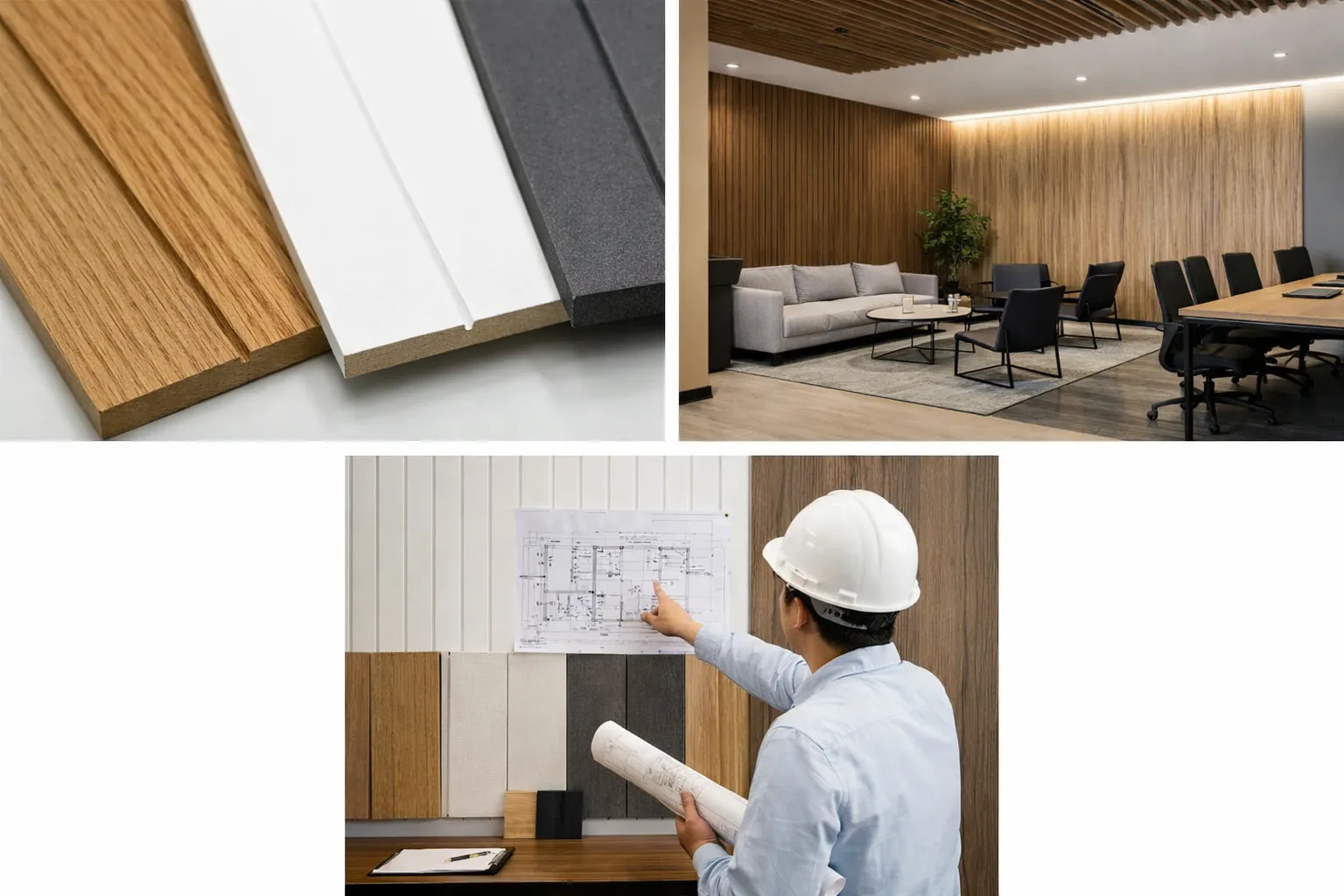
Pannelli di legno naturale di alta qualità Produttori e fornitori in Cina. Noi produciamo: Pannelli acustici in legno Pannelli in PET
Evita che la tua richiesta sia una risposta tardiva, inserisci il tuo WhatsApp/Skype insieme al messaggio, in modo da poterti contattare al primo colpo.
Vi risponderemo entro 24 ore. Se per il caso urgente, si prega di aggiungere WhatsApp/WeChat: +86-13678899682 direttamente.
Bad room sound can ruin a good space. Echo, harsh voices, and noisy reflections make offices, studios, and public interiors feel tiring. The fix is not always bigger construction. In many cases, the right acoustic solution—placed in the right spots—can make the room calmer, clearer, and easier to use.
Sì, pannelli acustici esagonali do work. They are designed to improve acoustics by increasing sound absorption, reducing reverb, and controlling reflected sound waves on hard interior surfaces. They do not usually make a room fully soundproof, but they can greatly improve speech clarity, comfort, and overall sound quality when specified and installed correctly. Reverberation time depends on room volume and total absorption, and absorptive finishes help minimize reverberation.

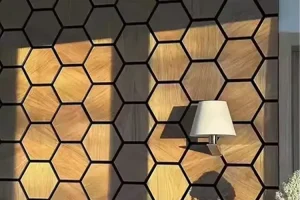
pannelli acustici esagonali
As a professional manufacturer in China specializing in high-quality PET and wood acoustic panel solutions, we work with global B2B buyers who need performance, design flexibility, and stable supply. Our customers include distributors, importers, architects, interior designers, project contractors, and brand owners seeking OEM/ODM solutions. In real projects, the question is rarely “Do they look good?” It is usually “Will they actually improve the room?” This guide answers that in a clear, practical way.
What are hexagon acoustic panels and how do they work?
Do hexagon panels improve sound absorption or just look decorative?
Are hexagon panels soundproof or only sound absorbing?
Where do hexagon acoustic panels work best?
How many panels do you need for better acoustics?
What materials are used in a modern acoustic panel?
How should you handle panel installation and adhesive selection?
Are hexagon panels better than foam panels or square panels?
What should B2B buyers check before ordering?
Why are hexagon wall panels a smart OEM/ODM product for global brands?
A hexagon acoustic panel is a sound-control product shaped like a six-sided panel and installed on walls or ceilings to manage reflected sound. Its job is not to stop all sound from leaving a room. Its main function is absorption. When sound waves hit the panel surface, part of the sound energy is absorbed instead of bouncing back into the room. That reduces harsh reflections and makes the space feel cleaner and more controlled. Sound absorption is the fraction of incident sound energy a material absorbs, and reverberation time is directly linked to the total amount of absorption in a room.
That is why hexagon panels are popular in offices, hospitality projects, schools, media spaces, and residential feature walls. They combine acoustic treatment with visual design. The hexagonal form helps designers build patterns that feel modern and eye-catching, while the absorptive core supports better listening conditions. In our own export projects, many clients choose this format because it is both functional and aesthetically pleasing.
For buyers building a product range, hexagon shapes also offer a flexible merchandising advantage. A simple rectangular panel can work well, but a unique shape often makes the product more memorable in catalogs, showrooms, and online listings. That matters for importers and brand owners who want products that solve real problems and also sell well.
They absolutely can improve sound absorption when the panel structure, density, thickness, and installation match the room’s needs. A panel is not effective just because it has an attractive shape. What matters is the material and the amount of treated surface area. Public acoustics guidance from GSA notes that absorptive wall finishes such as acoustic felt and fabric-based systems help minimize reverberation in a space.
In practical terms, hexagon acoustic panels help by reducing reflected mid- and high-frequency sound, which often improves speech clarity and comfort. In spaces used for communication, a lower reverberation time supports better intelligibility. Research and guidance from NRC and NIH show that reverberation has a direct effect on speech intelligibility and listening difficulty.
So yes, the effectiveness of hexagon panels is real. But there is an important condition: enough coverage has to be installed in the right locations. A few small decorative pieces may soften a room slightly. A well-planned layout can do much more.
Good acoustic design is not about adding random decoration. It is about placing enough absorptive surface where reflections are strongest.
This is one of the most important questions in the market. Most hexagon acoustic panels are sound absorbing, not fully soundproof. They improve the room by reducing reflected sound, echo and reverb, and overall listening fatigue. They usually do not block sound the way a heavy wall, multilayer partition, or isolation assembly would. GSA’s acoustic guidance specifically separates methods that block, absorb, and cover sound, because each approach solves a different problem.
That means these panels are ideal when the goal is reducing echo, cleaner speech, and better comfort inside a room. If the goal is to stop loud music from passing through a wall, a different system is needed. Buyers often confuse sound proofing with room treatment, but the two are not the same. One controls transmission. The other improves the acoustic environment inside the room.
A simple comparison helps:
| Obiettivo | Best approach | Do hexagon panels help? |
|---|---|---|
| Ridurre riverbero and reflections | Absorptive treatment | Yes |
| Migliorare la chiarezza del discorso | Sound absorption + better placement | Yes |
| Bloccare il suono tra le stanze | Mass, sealing, isolation assemblies | Limited |
| Make a room fully insonorizzato | Structural soundproofing system | No, not by themselves |
This distinction is useful for contractors, designers, and distributors because it helps set correct customer expectations from the start.
These panels work best in rooms with hard surfaces and audible reflections. That includes meeting rooms, open offices, hotel lobbies, classrooms, cafés, media rooms, showrooms, and many residential spaces. They are also a smart fit for conference rooms, home theater spaces, music practice rooms, and a home studio where speech or music clarity matters. Hard surfaces reflect sound strongly, while absorptive surfaces reduce reverberation and help listening conditions.
In larger public interiors, the goal is often better speech intelligibility. In creative spaces, the goal may be better sound and less flutter echo. In premium residential interiors, design matters just as much as performance. That is where hexagon wall products stand out. They are decorative enough for feature walls, but still useful as acoustical treatment.
A quick decision chart:
| Spazio | Common problem | Why hexagon acoustic panels work |
|---|---|---|
| Ufficio aperto | Reverb, distractions, poor speech clarity | Adds soft absorption on visible wall areas |
| Sala riunioni | Harsh reflections | Helps reduce echo and improve conversation clarity |
| Hotel corridor / lounge | Aumento del rumore | Softens the overall room feel |
| Recording studios or media rooms | Reflection control | Supports cleaner monitoring and playback |
| School / training room | Chiarezza del discorso | Helps speech carry more clearly |
They also work great as decorative panels for walls where both appearance and sound matter. That combination is one reason why the category continues to grow in commercial interiors.
There is no single number that fits every room. The right amount depends on room volume, surface finishes, ceiling height, furniture, and the target result. NRC guidance explains that total absorption in a room determines reverberation time, and the Sabine equation is often used to estimate how much absorptive area is needed.
In plain language, small rooms may improve with a modest amount of wall treatment. Larger rooms or rooms with many reflective finishes need more coverage. If you install only one panel on the wall in a very live room, you will hear only a slight change. If you treat first reflection zones and large hard surfaces, you will hear more. That is why placement around reflection points and on the wall opposite the main sound source often matters.
A practical planning guide looks like this:
Light treatment: visual upgrade plus small reduction in echo
Medium treatment: noticeable reduce echo and improve speech comfort
Heavy treatment: stronger reverberation control for more demanding spaces
For B2B projects, we usually advise clients to think in system terms, not single pieces. Hexagon formats are modular, so panels can be easily scaled up or down to match the room and budget.
Most modern panels are made from porous, fibrous, or felt-like materials that convert part of the acoustic energy into small amounts of heat through friction. Common categories include polyester, fiberglass, fabric-wrapped boards, acoustic foam, wood-faced systems with absorptive backing, and other engineered materials. NRC and GSA references both emphasize absorptive materials and finishes as key tools for reducing reverberation.
For global projects, PET felt is a strong option because it is durable, lightweight, easy to process into shapes, and visually clean. Wood-faced acoustic products are also popular where a warmer architectural look is needed. In our own manufacturing practice, buyers often compare PET and wood based on design language, application, thickness, and target market positioning rather than one “winning” material.
Here is a simple material comparison:
| Tipo di materiale | Strength | Common use |
|---|---|---|
| PET / poliestere felt | Lightweight, modern, easy to cut | Offices, schools, retail, wall décor |
| Wood acoustic panel systems | Premium visual finish | Hospitality, commercial interiors, feature walls |
| Pannelli rivestiti in tessuto | Strong performance and classic look | Meeting rooms, media rooms, education |
| Pannelli in schiuma | Budget-friendly for some applications | Small studios, DIY spaces |
Some buyers ask whether acoustic tiles or a decorative tile format can still perform well. The answer is yes, when the core material and panel thickness are right.
Good panel installation matters almost as much as panel quality. Even the best acoustic panel will underperform if it is installed in the wrong zone or with poor contact to the substrate. Common installation methods include mechanical fixing, hook-and-loop systems, rail systems, and adhesive bonding, depending on wall type, panel weight, and project requirements.
For lighter PET products, installers often choose adhesive methods. That can include construction adhesive or, in some settings, spray adhesive. The best option depends on substrate, finish, removal needs, and fire/safety requirements. If you are bonding to drywall, always test the adhesive first and confirm compatibility with the panel backing and paint system. In commercial projects, fire performance, finish stability, and maintenance access should be reviewed before the final method is approved.
From a buyer’s view, the most sellable systems are often panels that are easy to handle and easy to install. Installers like products that reduce labor time. Importers like products with fewer complaints. Contractors like systems that move fast on site. That is one reason modular hexagon layouts are attractive: panels can help combine design freedom with simple installation logic.
Not always better in every technical sense, but often better as a product choice. Square panels are efficient and easy to plan. Foam panels may suit simple studio setups. But hexagon panels offer a stronger design story. They give architects and brand owners more freedom to create feature walls that feel custom without needing complex fabrication.
In performance terms, shape alone is not the main factor. Material, thickness, density, air gap, and coverage matter more than whether the panel is round, square, or hexagon. The frequency range targeted by the panel is also important. Many thin absorbers work mainly on mid and higher frequencies, while lower frequencies usually need thicker treatment or systems like bass traps. Absorption coefficients depend on frequency, which is why acoustic data is usually reported at standard test bands rather than as one simple promise.
So why do so many designers choose hexagon? Because the panels perform and the panels look better in many decorative applications. They are more visually appealing, more distinctive on a feature wall, and easier to position as a premium line for design-led markets.

For distributors, contractors, and OEM/ODM buyers, the first question should be performance data. Ask about tested absorption values, intended applications, thickness, density, installation method, and finish options. If the product is meant for commercial interiors, check fire performance and whether the panel is suitable for the project environment. Acoustic performance is tied to tested absorption behavior and room design targets.
Second, check supply-chain realities. Can the factory customize color, size, bevel, backing, and packaging? Can it support mixed orders? Can it keep visual consistency from batch to batch? These points are critical for building material importers and brand owners.
Third, look at product-market fit. Do you need a clean PET solution for education and office projects? A wood finish for hospitality? A value line for online retail? Some buyers focus too much on what sells among brands on amazon, but serious B2B sourcing should start with project suitability and brand positioning, not just trend chasing.
A practical buyer checklist:
Acoustic test data
Material and finish options
Installation method
Project use case
Fire and compliance details
OEM/ODM packaging and labeling
Stable lead time and factory communication
From a product-development view, hexagon panels are versatile. They fit residential décor, education, offices, hospitality, and light studio applications. They are easy to color-match, repackage, and market across regions. They support visual storytelling. And because they solve a real acoustic problem, they are more than decorative paneling.
For OEM/ODM customers, that matters. You want a product that can be adapted for different channels and specific needs. A distributor may want neutral packaging. A designer brand may want premium finishes. A contractor may want bulk cartons and fast adhesive installation kits. A private-label buyer may want a ready-made product family with matching accessories. Hexagon formats are well suited to all of those paths.
As a China-based manufacturer, we see this category as a practical bridge between design and function. The market does not only want panels that absorb echo. It wants solutions that are scalable, attractive, and easy to specify. That is exactly why many buyers come to us for customized PET and wood acoustical panels with OEM/ODM support.
Do hexagon acoustic panels really reduce echo?
Yes. When they are made from absorptive materials and installed in enough quantity, they can absorb echo, reduce reflections, and lower perceived reverberation inside a room. Reverberation depends on room volume and total absorption.
Are hexagon acoustic panels soundproof?
Usually no. Most products in this category are not full soundproofing panels. They are mainly pannelli fonoassorbenti that improve the room’s internal listening quality rather than stop all sound transmission through walls.
Are hexagon panels suitable for a home theater or home studio?
Yes. They can be useful in a home theater or home studio to reduce reflections and improve clarity. Placement matters, especially at strong reflection zones and on large hard surfaces.
What is better for offices, PET or pannelli acustici in legno?
Both can work. PET panels often suit flexible, modern commercial interiors. Wood systems may fit premium projects where the finish matters more. The better choice depends on budget, design, and acoustic targets.
Can I install hexagon acoustic panels with adhesive?
Often yes. Many lightweight products use adhesive systems, but the right method depends on the substrate, panel weight, finish, and whether future removal is needed.
Are hexagon acoustic panels good for conference rooms?
Yes. They are often a smart choice for conference rooms because they help reduce reflected sound and support clearer speech, which can improve meeting comfort and communication. Reverberation control is closely tied to speech intelligibility.
Hexagon acoustic panels do work when they are made from real absorptive materials and installed in the right amount.
They improve acoustics mainly through sound absorption, not full sound proofing.
They help reduce reverb, reflections, and listening fatigue in offices, schools, hospitality, media rooms, and residential interiors.
Shape is useful for design, but material, thickness, placement, and coverage matter more for performance.
For B2B buyers, the best product is not only decorative. It should also be easy to specify, easy to install, and supported by stable factory supply.
PET and wood formats both have strong market value, especially for distributors, contractors, architects, and OEM/ODM brand owners.

 Italian
  English
  French
  German
  Spanish
  Arabic
  Russian
  Dutch
Dutch