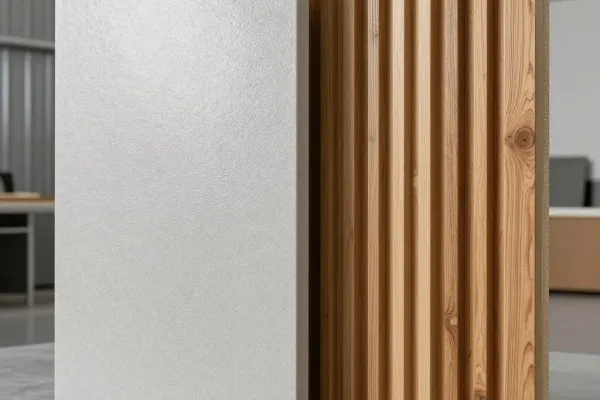
Hochwertige Naturholzpaneele Hersteller und Lieferanten in China. Wir produzieren: Holz-Akustik-Paneele PET-Paneele
Vermeiden Sie, dass Ihre Anfrage verspätet beantwortet wird, geben Sie bitte Ihre WhatsApp/Skype-Nachricht mit an, damit wir Sie sofort kontaktieren können.
Wir werden Ihnen innerhalb von 24 Stunden antworten. Wenn für dringenden Fall, fügen Sie bitte WhatsApp/WeChat: +86-13678899682 direkt.
Choose an acoustic panel manufacturer by verifying four things in writing: certificate numbers and their exact scope, the tested model behind each fire rating, which production steps happen in-house, and MOQ and lead-time terms for your specific model.
Most supplier-selection articles in this category tell you to compare price, check quality, and read reviews. That advice is not wrong, but it does not survive contact with a real sourcing process, because every factory you contact will claim all three. The useful question is narrower: what document, sent by email, would let you disprove a supplier’s claim if it were false?
The steps below are ordered the way a first-time evaluation usually runs — cheapest checks first, so you disqualify the obvious mismatches before you spend money on samples and travel.
I’ve written this from the manufacturing side. That is a bias worth naming: I run a panel factory, so I am describing the questions I think buyers should ask us, and some of them are questions we cannot fully answer either. Where that applies, I’ve said so.

“CE certified” and “FSC certified” are not verifiable statements. A certificate number, an issuing body, and an expiry date are.
Ask for a table like this from any shortlisted supplier, filled in with their own documents. For reference, here is ours:
| Document | Number | Issued By | Scope as Written | Validity |
|---|---|---|---|---|
| FSC Chain of Custody | GFA-COC-008037 | GFA Certification GmbH | Production and trade of certain non-timber forest products, mouldings, other wood products, and wooden sound-absorbing boards (FSC-STD-40-004 V3.1) | 29 Oct 2024 – 28 Oct 2029 |
| CE Type Examination | DE/7552 | CSI S.p.A. (Italy) | Decorative wall covering, model “BEIEN WALL PANEL,” EN 15102:2007+A1:2011 | 11 Jun 2024 – 10 Jun 2029 |
| Fire Classification Test | SHFS2403000289FF (Ref. SHIN2403000573CM01) | SGS-CSTC Standards Technical Services (Shanghai) | Polyester sound-absorbing board, sample BN-002, 100% polyester fiber, 1,700 g/m², 9 mm, 2420 × 1220 mm | Report dated 1 Apr 2024 |
| amfori BSCI Monitoring | 25-0326232 | APCER (Monitoring Partner) | Full monitoring, rating C | Expired 9 Jun 2026 |
Two things about that table are worth copying into your own evaluation.
First, the scope column is the whole point. FSC Chain of Custody covers material flow through certified product groups; it does not mean every veneer on every order is FSC. If a supplier offers you FSC-certified oak, the correct follow-up is whether the specific veneer and specific order will be invoiced with an FSC claim.
Second, we listed an expired document. Our BSCI monitoring report lapsed on 9 June 2026 and a renewed report has not yet replaced it. A supplier who quietly leaves lapsed audits on a certificate page is telling you something about how they handle documentation generally — and if you find one, ask when renewal is scheduled rather than assuming bad faith.
This is the step where most sourcing errors happen, and it deserves more attention than the certification count.
A fire classification belongs to a tested configuration: one material, one density, one thickness, one surface. Our SGS report gives EN 13501-1:2018 class B-s2,d0 for a 9 mm polyester board at 1700 g/m², sample BN-002. That result does not automatically transfer to a 12 mm panel, a printed surface, a veneered PET panel, or a slat product built from the same felt.
Watch for the specific failure case: a product page that shows a fire rating in the specification table while the underlying report covers a different thickness. It happens on our own site — our PET slat panel page displays an ASTM E84 Class B / EN 13501 B-s1,d0 option that is not backed by a report we can hand you today, and we do not use that claim in quotations. If your project is code-driven, ask for the report PDF before the sample, not after.
Capacity claims — square metres, production lines, employee counts — are the least useful numbers on a supplier website, because nobody audits them. Process ownership is more informative and easier to check on a video call.
Ask the supplier to walk a camera through these stations:
BEIEN‘s plant occupies a 20,000 m² base with roughly 6,000 m² of active production area, and our acoustic-material manufacturing goes back to 2009. Those figures matter far less to your decision than whether the five stations above exist under one roof.
Before you request samples, put the supplier’s catalogue and their product pages side by side. Discrepancies between the two are common across this category, and they predict the problems you will have at order confirmation.
Real examples from our own documentation, which we are in the middle of reconciling:
If a supplier cannot explain a discrepancy like this, that is a warning. If they can, and they correct the document, that is a reasonable outcome. What you should not accept is a confirmed pro forma invoice that repeats an ambiguous dimension — resolve it before the deposit, because a 20 mm difference in sheet length changes yield on a cut-to-size project.

Quote the supplier your actual first purchase, not a hypothetical container. The answer tells you whether they are set up for the order size you have.
Specify: model, colour, thickness, quantity, packaging, and whether you need your own label. Then ask for MOQ per SKU, not per order — the difference between “50 panels” and “50 panels per colour” is the difference between a viable trial and dead stock.
Our published lead time is roughly 7–15 working days depending on quantity and customisation, and MOQ needs confirming per product family because of the inconsistency described above. Any supplier’s stated lead time should be tested with one more question: does that clock start at deposit receipt, at artwork approval, or at raw-material arrival?
For private-label buyers, add these to the same email: custom Pantone or RAL matching, custom sizes and thicknesses, CNC-cut shapes, engraving, custom labels, and own-logo packaging. Getting a written yes or no on each avoids the common outcome where “full customisation” turns out to mean colour only.
Q: Is a manufacturer always better than a trading company?
A: Not always. A factory gives you direct control over process and usually better pricing at volume. A trading company can be preferable if you need consolidated shipments from several product categories. The mistake is not knowing which one you have — check whether the certificate holder and the export entity are the same company.
Q: How many certificates should a legitimate acoustic panel supplier hold?
A: There is no correct count. Relevance beats quantity: a fire classification matching your product and market, material or emissions documentation if you are selling into regulated interiors, and a chain-of-custody certificate if you are buying certified timber. A long certificate wall with no matching report numbers is weaker evidence than one correctly scoped SGS report.
Q: Can a supplier apply one fire test report to their whole product range?
A: No. Classification under EN 13501-1 applies to the tested product configuration — material, density, thickness, and surface. A different thickness or a veneered surface needs its own test. Ask which sample the report covers.
Q: What MOQ is realistic for a first trial order?
A: In this category, trial quantities in the range of tens of panels are workable with many factories, ours included, though the exact figure depends on product family, finish, and customisation level. Confirm whether the MOQ applies per order or per colour.
Q: How do I verify an FSC claim?
A: Take the certificate code — ours is GFA-COC-008037 — and check it against the FSC public certificate search, which shows the holder, status, and product groups in scope. Then confirm the specific order will be invoiced with an FSC claim, since holding the certificate and selling you certified material are two different things.
Q: What should I do if a supplier’s audit report has expired?
A: Ask when the renewal audit is scheduled and request the new report when issued. Expiry alone is not disqualifying — audits lapse between cycles. Presenting an expired report as current is the actual problem.
Q: Should I ask for customer references or case studies?
A: You can, but weigh them lightly unless they include a named client, a verifiable project, and a documented result. Many case studies in this industry, including some we have chosen not to publish, cannot be substantiated to that standard. A pre-shipment inspection report tells you more than an unnamed project photo.

 German
  English
  French
  Italian
  Spanish
  Arabic
  Russian
  Dutch
Dutch