Hochwertige Naturholzpaneele Hersteller und Lieferanten in China. Wir produzieren: Holz-Akustik-Paneele PET-Paneele
Vermeiden Sie, dass Ihre Anfrage verspätet beantwortet wird, geben Sie bitte Ihre WhatsApp/Skype-Nachricht mit an, damit wir Sie sofort kontaktieren können.
Wir werden Ihnen innerhalb von 24 Stunden antworten. Wenn für dringenden Fall, fügen Sie bitte WhatsApp/WeChat: +86-13678899682 direkt.
A noisy room does not always need “soundproofing.” Many times, the real problem is echo, hard surfaces, and poor room acoustic treatment. Choose the wrong acoustic panel, and the room still feels loud. Choose the right solution, and speech becomes clearer fast.
Acoustic panels usually reduce perceived room noise by about 3–10 dB in real interior projects, depending on panel material, thickness, coverage, placement, and room conditions. Acoustic panels reduce echo and reverberation; they do not normally block traffic noise, machine noise, or sound transmission through walls.
Most buyers do not ask about an acoustic panel because they love technical data. They ask because a real project has a real problem. A meeting room sounds hollow. A restaurant feels too loud. A classroom has poor speech clarity. An office team complains about noise fatigue.
So the question “how many decibels do acoustic panels reduce?” often means something deeper:
For B2B buyers, this question is also about risk. Distributors do not want product returns. Contractors do not want rework. Architects do not want beautiful interiors that sound bad. Brand owners do not want to sell panels that look good but fail in real spaces.
The honest answer is this: acoustic panels can significantly reduce noise caused by reflections, echo, and reverberation. But they are not magic boards. They must be selected and installed according to the room problem.
Before choosing acoustic materials, you must define the problem. Many failed projects happen because the buyer says “noise,” but the actual issue is not clear.
There are usually three different problems.
| Problem Type | What the User Feels | Main Cause | Best Solution |
| Echo and reverberation | Speech sounds unclear and room feels hollow | Hard walls, glass, concrete, tile | Acoustic panel, wall panels, ceiling panels |
| Loud indoor activity | Room feels busy and tiring | Many people or sound sources | Acoustic treatment and layout control |
| Sound from outside or next room | Noise passes through walls, windows, doors | Weak isolation | Soundproof construction, seals, mass, barriers |
An acoustic panel mainly solves the first two. It helps absorb sound waves inside the room. It does not usually prevent sound from passing through walls. If the client expects wall panels to stop traffic noise, neighbor noise, or heavy machine noise from another room, the result will disappoint them.
This is why professional suppliers should not sell “one panel solves all noise.” Instead, we should ask: where does the noise come from, how does sound travels in the room, and what result does the project need?
In many commercial interiors, a well-planned acoustic panel system can reduce perceived room noise by about 3–10 dB. In some echo-heavy spaces, the improvement may feel stronger because the room becomes clearer and less harsh.
A 3 dB reduction may sound small, but the decibel scale is logarithmic. According to the National Institute on Deafness and Other Communication Disorders, sound measurement is not linear. A small change in decibel level can still be meaningful to human hearing.
The real result depends on several factors:
| Project Situation | Typical Improvement | What It Means |
| Few decorative panels only | 1–3 dB | Small improvement, mainly visual |
| Medium wall panel coverage | 3–6 dB | Better speech comfort |
| Wall panels plus ceiling panels | 5–10 dB | Noticeable noise reduction in many spaces |
| Full acoustic treatment plan | 8–12 dB or more | Possible in difficult echo spaces, depends on design |
| Soundproofing requirement | Acoustic panels alone are not enough | Need isolation construction |
The key point is simple: acoustic panels reduce reflected sound, not the original sound source itself. If a person speaks at the same volume, the direct voice remains. But the room no longer throws the voice back again and again. That is why the room feels calmer.
This is one of the most important questions for buyers. Many projects use acoustic panels, but the final result is weak. The problem is not always the panel itself. Often, the project made one of these mistakes.
One or two wall panels cannot change a large office, restaurant, or classroom. Panels reduce echo by absorbing sound energy. If the treated area is too small, most sound waves still hit hard surfaces and bounce back.
Panels placed only for decoration may miss the main reflection areas. The panel looks good, but the acoustic treatment does not work well. In meeting rooms, panels at first reflection points often matter more than panels placed randomly.
Very thin panels may absorb high-frequency sound but perform poorly at lower frequencies. Thicker panels usually absorb more sound energy and give more balanced acoustic performance.
Some buyers expect acoustic panels to block outdoor noise. That is not their main job. If the issue is sound transmission, you need walls, doors, windows, seals, and mass-based soundproofing.
Low-density materials, poor backing, weak bonding, inaccurate cutting, and unstable finishing can all reduce the final quality. In B2B projects, the lowest price often becomes expensive when the site needs replacement or additional treatment.
The purpose of acoustic panels is to absorb sound. When sound waves hit a hard surface, they reflect. When they hit a suitable acoustic panel, part of the sound energy enters the panel and changes into tiny heat through friction inside the material.
This is the science behind acoustic panels in practical terms. The panel does not “delete” sound. It reduces how long sound lingers in the room. The shorter the reverberation time, the clearer the room feels.
For example, in a meeting room with glass walls and a hard floor, voices bounce from one surface to another. People talk louder because they cannot hear clearly. This creates more noise. After adding acoustic wall panels and ceiling panels, the room becomes easier to speak in. People naturally lower their voice.
That is why acoustic panels can reduce noise levels in two ways:
This second effect is important in offices, restaurants, schools, call centers, and public buildings.
How Does Sound Absorption Affect the Final Noise Level?
Sound absorption vs soundproofing is not a small detail. It decides whether the project succeeds.
Sound absorption means controlling sound inside a room. Soundproofing means blocking sound from entering or leaving a room. Acoustic panels are designed to absorb sound, not to replace heavy partitions.
| Customer Complaint | Likely Problem | Will Acoustic Panels Help? |
| “The room has too much echo.” | Reverberation | Yes |
| “People cannot hear clearly in meetings.” | Reflections and poor speech clarity | Yes |
| “The restaurant is too loud when full.” | Reflected crowd noise | Yes |
| “Traffic noise comes through the window.” | External sound transmission | Limited help |
| “Noise passes through the wall.” | Wall isolation problem | Not enough alone |
| “Machines are too loud.” | Source noise and reflection | Panels help reflection, not source level |
This is where B2B sellers can build trust. Do not promise that acoustic panels will solve every noise problem. Explain what they can and cannot do. Serious buyers prefer honest guidance because it protects their project.
For technical reference, ISO 354 describes measurement of sound absorption in a reverberation room, and ASTM C423 is widely used for sound absorption and absorption coefficient testing. These standards help buyers compare acoustic products more professionally. See ISO 354 und ASTM C423.
B2B buyers need more than nice photos. A good acoustic panel should be judged by performance, safety, appearance, installation, and supply stability.
| Spezifikation | Warum es wichtig ist |
| Material | PET, wood, fabric, fiberglass, mineral wool, or hybrid structure affects use and performance |
| Dicke | Thicker panels usually offer better sound absorption |
| Dichte | Impacts acoustic performance and panel strength |
| NRC value | Shows general sound absorption ability |
| Fire rating | Important for commercial and public projects |
| Size tolerance | Affects installation quality |
| Oberflächengüte | Impacts interior design value |
| Color consistency | Important for batch orders |
| Packaging | Reduces transport damage |
| OEM/ODM support | Helps distributors and brand owners build product lines |
The noise reduction coefficient, often called NRC, is one common way to compare sound absorption. A higher NRC usually means better absorption in the tested range. USG provides a useful explanation of NRC and acoustic performance in its Acoustics 101 guide.
However, NRC is not the only factor. Installation method, air gap, room layout, and panel distribution also affect the final result. A high-NRC panel installed in the wrong place may still perform poorly.
Different acoustic materials serve different project needs. The right choice depends on the space, budget, design style, and local market requirements.
PET acoustic panels are lightweight, clean, modern, and easy to customize. They are often used in offices, schools, retail spaces, meeting rooms, and public areas. They can be cut into many shapes and colors, making them useful for both function and design.
Wood acoustic panels are popular for hotels, restaurants, villas, offices, showrooms, and premium public spaces. They combine decoration with sound absorption. Slatted wood panels with acoustic felt backing can improve sound quality while adding a warm interior style.

Fabric-wrapped panels can provide strong absorption and a soft visual effect. They are common in studios, meeting rooms, auditoriums, and theaters.
Ceiling panels are useful where wall space is limited. Open offices, schools, and large commercial areas often benefit from ceiling treatment because sound reflects strongly from above.
For our manufacturing work, PET and wood acoustic panels are especially valuable for global B2B customers because they balance design, shipping efficiency, customization, and acoustic treatment. They are also suitable for OEM/ODM product development.
Good acoustic treatment depends on placement. If panels are only placed where they look nice, they may not solve the real problem.
For meeting rooms, place panels near first reflection points, behind the speaker area, on side walls, and sometimes on the ceiling above the table. For restaurants, spread panels across large reflective surfaces and consider ceiling baffles. For classrooms, treat the rear wall and ceiling to improve speech clarity.
place acoustic panels at first reflection points
The best placement of panels should follow the user behavior in the room. Where do people speak? Where do they listen? Where does echo return? Where are the largest hard surfaces? These questions matter more than decoration alone.
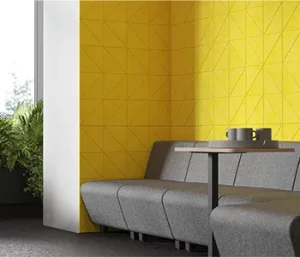
Wall panels are the most common acoustic solution because they are easy to install and easy to combine with interior design. They can become part of the visual identity of the room.
Ceiling panels are often better for large spaces. In open offices, restaurants, schools, and public buildings, the ceiling is usually one of the biggest reflective surfaces. If the walls are glass, shelves, or decorative stone, ceiling treatment may be the best option.
| Option | Am besten für | Main Advantage |
| Wandtafeln | Meeting rooms, offices, hotels, corridors | Easy design integration |
| Deckenplatten | Open offices, restaurants, classrooms | Large acoustic coverage |
| Wall + ceiling system | High echo spaces | Better overall sound control |
| Akustikwandplatten aus Holz | Premium interiors | Decoration plus acoustic function |
| PET ceiling baffles | Commercial spaces | Lightweight and flexible layout |
In many real projects, the strongest result comes from combining both. Wall panels reduce side reflections. Ceiling panels reduce overhead reflections. Together, they create a better sound environment.
There is no single number because each room is different. But for project planning, a useful starting point is to treat about 20–40% of the main reflective surfaces. More difficult rooms may need more.
| Space Type | Suggested Acoustic Approach |
| Small meeting room | Treat side walls, rear wall, and ceiling cloud if needed |
| Offenes Büro | Use ceiling panels plus selected wall panels |
| Klassenzimmer | Treat rear wall and ceiling area |
| Restaurant | Use wall panels, ceiling baffles, and soft interior materials |
| Hotel lobby | Combine decorative wood acoustic panels with ceiling treatment |
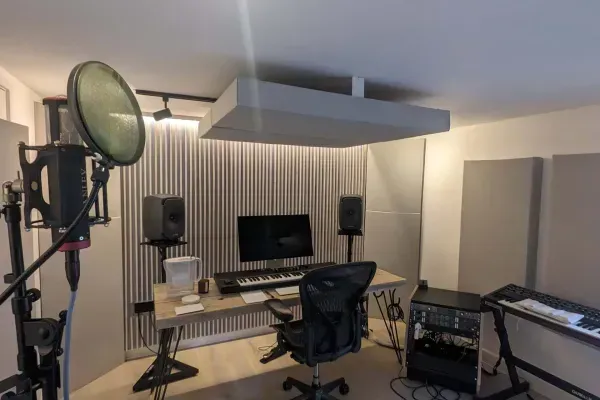
| Recording room | Use a professional acoustic layout, not only decorative panels |
| Public hall | Use high-coverage wall and ceiling acoustic treatment |
If a client asks “how many panels do I need?”, the right answer should include room size, ceiling height, surface materials, target result, and panel specification. A good supplier should help calculate coverage instead of simply selling more panels.
This is also where custom manufacturing becomes valuable. Standard panels may not fit every project. Custom sizes, shapes, colors, slots, grooves, backing materials, and packaging can help the project look better and install faster.
For B2B buyers, product quality is only one part of the decision. The supplier must also support stable production, customization, packaging, export, and project communication.
A reliable acoustic panel supplier should help you answer these questions:
As a professional manufacturer in China specializing in high-quality PET and wood acoustic panels, we support global B2B clients with customized acoustic panel solutions. Our customers include building material distributors, importers, architects, interior designers, commercial contractors, and brand owners seeking OEM/ODM acoustic panel products.
We understand that our clients do not only need panels. They need a product line that sells, installs well, looks consistent, and solves real acoustic challenges.
PET and wood acoustic panel manufacturer for B2B projects
A restaurant owner complains that customers cannot talk comfortably during peak hours. The designer adds a few decorative wall panels near the entrance. The room looks better, but the noise problem stays.
Why? Because the main sound energy comes from the dining area, hard floor, exposed ceiling, glass windows, and many sources of sound at the same time. The panels are too few and too far from the main reflection zones.
A better solution would include:
This kind of solution can reduce unwanted echo and improve comfort without changing the restaurant’s design style. It also gives the contractor a clearer reason to recommend more complete acoustic treatment.
A company installs several thin decorative panels behind the TV wall. The meeting room still sounds sharp. People on video calls complain that speech is not clear.
The reason is simple. The panels are on one wall only. The side walls and ceiling still reflect sound. The table is hard. The glass partition reflects voices. The acoustic panel placement does not match the sound path.
A better plan would include:
This is why panel placement is not a decoration decision only. It is a project performance decision.
Before ordering acoustic panels, buyers should define the room problem clearly. Is it echo? Is it sound transmission? Is it machine noise? Is it speech clarity? The answer changes the product choice.
Then buyers should confirm material, thickness, NRC, fire rating, color, size, installation method, and packaging. For commercial projects, these details affect both performance and project acceptance.
The best acoustic solution is not always the most expensive one. It is the one that matches the room, target result, and budget. In many B2B projects, a well-designed PET or wood acoustic panel system can solve the main problem and improve the value of the interior space.
Akustikplattenfabrik
Yes. Acoustic panels can reduce decibels related to reflected sound inside a room. In many commercial spaces, the improvement is around 3–10 dB when the panel coverage, material, and placement are correct. The room also feels clearer because echo is reduced.
The most common reasons are too few panels, wrong placement, thin material, low-density core, or wrong expectation. If the noise comes through walls, windows, or doors, acoustic panels alone will not solve the problem.
No, not effectively. Acoustic panels mainly absorb sound inside the room. To block outside noise, you need soundproof windows, sealed doors, heavier walls, and proper construction details.
Yes. PET acoustic panels are lightweight, customizable, and suitable for offices, schools, meeting rooms, retail spaces, and public buildings. They are also good for distributors and OEM/ODM brands because they are easy to produce in different sizes, colors, and shapes.
No. Wood acoustic panels can provide both decoration and acoustic performance when designed with slots, grooves, perforations, or acoustic felt backing. They are widely used in hotels, restaurants, offices, villas, and premium commercial interiors.
A simple starting point is 20–40% coverage of the main reflective surfaces. However, the final amount depends on room size, ceiling height, surface materials, and target sound quality. Large or echo-heavy rooms often need wall and ceiling treatment together.

 German
  English
  French
  Italian
  Spanish
  Arabic
  Russian
  Dutch
Dutch