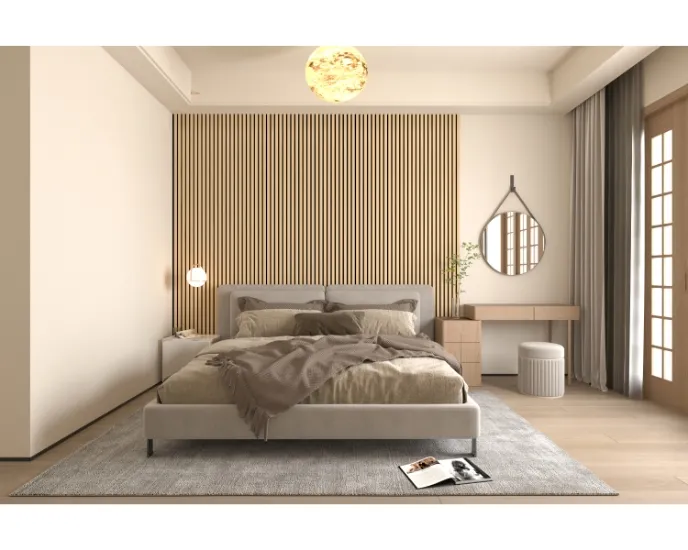
ألواح الخشب الطبيعي عالية الجودة مصنعي وموردي ألواح الخشب الطبيعي في الصين. نحن المنتج: الألواح الخشبية الصوتية ألواح الخشب الصوتي ألواح PET
تجنب تأخير الرد على استفسارك، يُرجى إدخال واتساب/سكايب الخاص بك مع الرسالة، حتى نتمكن من الاتصال بك في المرة الأولى.
سنرد عليك في غضون 24 ساعة. إذا كانت الحالة عاجلة، يُرجى إضافة واتساب/وي تشات: +86-13678899682 مباشرة.
Natural veneer acoustic panels use wood sliced directly from the log, so every panel has its own grain and colour variation. Technical veneer panels use engineered veneer with a repeatable pattern, so panels match each other more closely. Natural veneer suits projects that want species character. Technical veneer suits large uniform elevations, three-side coverage and repeatable finishes.
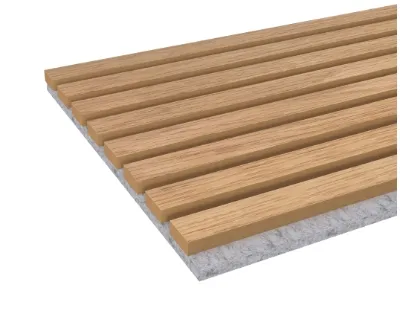
Both are wood surfaces laminated onto acoustic slat panels. The difference is where the grain pattern comes from.
Natural veneer is sliced from a single species of timber. The figure, colour and knots you see come from that log. No two panels are identical, and two production batches can differ visibly.
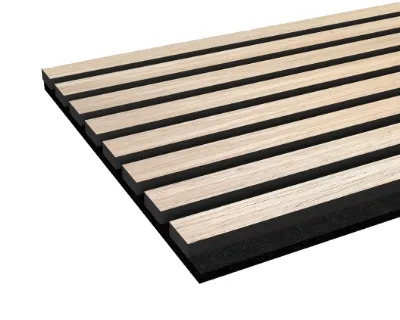
Technical veneer is also called engineered or reconstituted veneer. It is still wood, but the grain pattern is made during manufacturing instead of being taken from one log. The pattern repeats, so colour and figure stay closer from panel to panel and from order to order.
This one difference affects several later decisions: how forgiving the panel is on a 12-metre feature wall, how reorders match, which finishes are available, and how certificate claims apply.
| Dimension | Natural Wood Veneer (NBW series) | Technical Wood Veneer (TBW series) |
| Veneer source | Natural species veneer | Engineered (technical) veneer |
| Grain consistency | Varies panel to panel and batch to batch | Repeatable pattern, closer batch match |
| Published finishes | Oak, walnut, ash, teak, maple, zebra wood, smoke oak; other veneers by customization | Classic Oak, Rustic Oak, Light Walnut, Classic Brown Oak, Grey Oak, Black Walnut, Smoke Oak, Dark Brown Oak, Ebony, Black Oak |
| Model references | NBW-01 to NBW-05, plus further NBW finishes on individual pages | TBW-01 to TBW-11 (2026 catalog); TBW-12 on current website |
| Veneer coverage | Not listed as a standard option; ask at quotation | One-side or three-side veneer |
| Acoustic felt colour | Custom felt colour available | Black or grey |
| Thickness / size | Commonly 21 mm thick; lengths of 600, 2400, 2700 or 3000 mm; width approx. 605 mm | Custom length and slat configuration; standard sizes confirmed at quotation |
| Customization | Panel size, slat width, depth, spacing, veneer, felt colour | Length, slat configuration, OEM packaging and branding |
| FSC | FSC-certified veneer available on request; not automatic for every finish | FSC claim only where the order falls within certificate scope |
The table shows a basic trade-off. NBW gives more control over the panel geometry and species. TBW gives a more predictable surface and more edge-finishing options.
On a small reception wall, natural variation is usually the reason to choose natural veneer. Designers often want visible oak figure or the stripe of zebra wood.
The risk grows with scale and with time. Three situations deserve attention:
Technical veneer reduces all of these risks because the pattern is manufactured. It does not remove them completely. Any wood product can shift slightly in tone, so approve a physical sample that represents the production run, not a catalog image.
If the client wants natural veneer on a large wall, order the full quantity in one batch and plan the panel layout before installation.
BEIEN offers the TBW series in two coverage configurations:
This matters more than it seems. On a slat panel, the gaps between slats expose the slat edges. You will see those edges when the wall is viewed at an angle, along a corridor, on ceilings and at external corners. If the edges are not wrapped in veneer, the wall reads differently at oblique angles than it does head-on.
Choose three-side veneer where people see the wall mostly at an angle: corridors, stair walls, ceilings and columns. One-side veneer can work where the wall is mainly seen from the front, such as behind a reception desk. Check edge appearance on a sample in either case.

Acoustic felt shows in every gap, so it works as a second surface colour.
TBW panels come with black or grey felt. Black felt makes the gaps read as shadow lines, which emphasizes the slat rhythm. Grey felt lowers the contrast, which suits light finishes like Grey Oak or Classic Oak when the designer wants a calmer surface.
NBW panels allow custom felt colours, which helps when the felt has to match a brand colour or a fabric elsewhere in the room.
For BEIEN’s wood slat acoustic panel range, the published construction is:
| Parameter | Published value |
| Slat substrate | MDF, approx. 760–800 kg/m³ density |
| Veneer thickness | Approx. 0.4–0.5 mm |
| Raw-material policy | E0-grade MDF |
| Acoustic backing | Polyester-fibre (PET) felt, produced in-house |
| التطبيقات | الجدران والأسقف |
| Wood slat series catalog sizes | 2400 / 2700 / 3000 × 605 × 18 or 21 mm; other sizes by customization |
| CNC cutting tolerance (factory) | ±0.3 mm |
For curved surfaces: BEIEN’s ألواح صوتية منحنية use a technical wood veneer surface on vertical slats over a PET backing. The panel bends along the slat direction, so the same panel can follow columns, curved walls and wave-shaped surfaces. Dimensions for curved panels are confirmed by model.
Pricing is quotation-based. It depends on panel type, dimensions, thickness, surface finish, fire-performance requirements, customization level, packaging, order quantity and shipping terms.
MOQ is confirmed by product family and customization level at quotation. BEIEN supports trial orders, subject to product confirmation. The publicly stated standard production lead time is approximately 7–15 working days, depending on order quantity and customization.
بالنسبة ل quotation, include the following: the veneer line (NBW or TBW) and model or finish; coverage and felt colour; panel dimensions and total area; wall or ceiling application; any curved surfaces; the certificates or test reports your project needs; and whether you need private-label packaging. With these details, you can get a quote and a sample plan in one round of messages.
Is technical veneer real wood?
Yes. Technical (engineered) veneer is made from wood, but its grain pattern is produced in manufacturing rather than taken directly from a single log. As a result, its appearance repeats more consistently than natural veneer.
Which BEIEN veneer line offers three-side veneer?
The TBW technical veneer series is available as one-side or three-side veneer. BEIEN does not list three-side coverage as a standard option for the NBW natural veneer series, so confirm it at quotation if you need it.
Are BEIEN veneer acoustic panels FSC certified?
BEIEN holds FSC Chain of Custody certificate GFA-COC-008037. FSC-certified veneer is available, but the FSC claim applies only to orders that are specified and documented as FSC. It does not apply to every finish by default.
What is the fire rating of BEIEN wood veneer acoustic panels?
BEIEN’s current register has no fire classification report specific to its veneer slat panels. The SGS B-s2,d0 result on file applies to a 9 mm PET board sample (BN-002). Request a report for the veneer configuration your project needs.
Can wood veneer acoustic panels be used on curved walls?
Yes, with the right construction. BEIEN’s curved acoustic panels combine a technical wood veneer surface with vertical slats on a PET backing. They bend along the slat direction to follow columns and curved walls.
How much do wood veneer acoustic panels cost?
Pricing is quotation-based. It depends on panel type, dimensions, thickness, finish, fire-performance requirements, customization, packaging, quantity and shipping terms.

 Arabic
 English
 French
 German
 Italian
 Spanish
 Russian
 Dutch