ألواح الخشب الطبيعي عالية الجودة مصنعي وموردي ألواح الخشب الطبيعي في الصين. نحن المنتج: الألواح الخشبية الصوتية ألواح الخشب الصوتي ألواح PET
تجنب تأخير الرد على استفسارك، يُرجى إدخال واتساب/سكايب الخاص بك مع الرسالة، حتى نتمكن من الاتصال بك في المرة الأولى.
سنرد عليك في غضون 24 ساعة. إذا كانت الحالة عاجلة، يُرجى إضافة واتساب/وي تشات: +86-13678899682 مباشرة.
Commercial acoustic wall panels are wall-mounted absorptive linings specified to control reverberation in offices, schools, and public buildings. For contractors, the decisions that matter are panel dimensions, substrate thickness, fixing method, fire documentation scope, and how the panels arrive palletised on site.
The phrase “acoustic wall panel” covers products that behave very differently once they reach a wall.
A porous polyester panel absorbs across mid and high frequencies through its fibre structure. A wood slat panel absorbs through the gaps between slats, with the polyester backing doing the acoustic work behind them; the timber face is largely a visual and structural element. Both are surface-mounted linings. Neither is a soundproofing product, and neither reduces sound transmission between two rooms in any meaningful way.
That distinction matters on site more than it does in a specification. When a client walks a finished meeting room and says they can still hear the corridor, the panels did not fail — the partition did. Getting this on record in an RFI before installation is worth the ten minutes it takes.
For fit-out work, the practical selection question is usually not acoustic at all. It is: what is the substrate, how flat is it, what fixing depth is available, and what does the fire strategy require of the wall lining?

BEIEN manufactures two families that dominate commercial wall work.
لوحة صوتية من البولي إيثيلين تيريفثاليت sheets are flat 100% polyester-fibre boards, cut and fixed like a soft sheet material. They suit large ceiling and wall fields, CNC-cut shapes, baffles, and any area where colour matching to a brand palette matters. Colour references BP-01 through BP-54 appear in the 2026 catalogue, with more than 40 standard colours and Pantone or RAL matching available on custom orders.
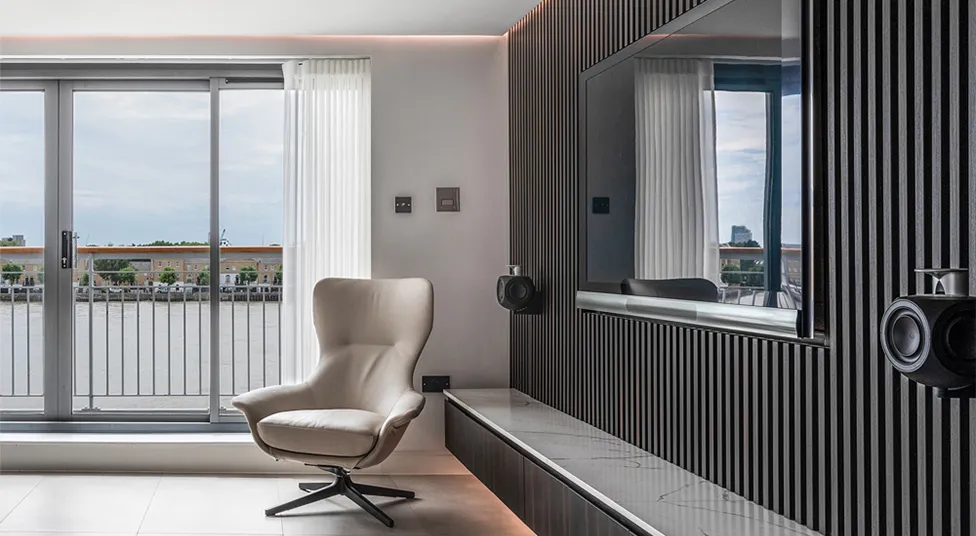
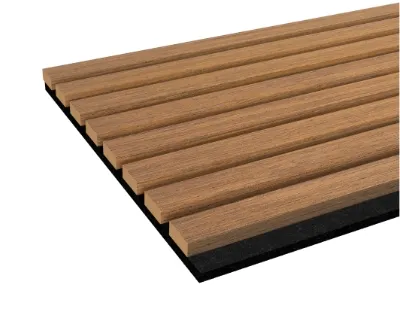
Wood slat acoustic panels are MDF slats on a polyester-fibre backing, finished with wood veneer or a decorative surface. Profiles BN-01 to BN-05 cover the standard slat geometries. These are the panels specified when the client wants a timber wall that also does acoustic work — reception walls, boardrooms, hotel corridors, lecture theatre side walls.
Compared with the perforated gypsum and perforated MDF systems commonly specified for the same applications, both families are lighter per panel and installed as a surface lining rather than as a jointed, taped, and decorated ceiling or wall system. That changes the trade sequencing: there is no drying time, no skim, and no subsequent decoration, but there is also no ability to hide a poorly set-out substrate behind filler.
| Dimension | PET Acoustic Panel Sheets | الألواح الصوتية الخشبية الشرائحية الخشبية |
|---|---|---|
| المواد الأساسية | 100% polyester fibre | MDF slats + polyester-fibre backing |
| Catalogue sheet/panel size | 1220 × 2420 mm | 2400 / 2700 / 3000 × 605 mm |
| Thickness options | 9, 12, 15, 24 mm | 18 or 21 mm |
| Face finish | 40+ standard colours, Pantone/RAL matching | Wood veneer 0.4–0.5 mm, PVC surface, or technical veneer |
| Model references | BP-01 – BP-54 | BN-01 – BN-05 |
| Fabrication on site | Cut with blade or CNC; edges left raw | Cut to length; slats and backing cut together |
| Fire report on file | SGS report covering a 9 mm polyester board sample (see below) | No product-specific fire report currently on file |
| Published NRC / αw | Not published | Not published |
| Typical wall use | Full-height fields, acoustic art, CNC shapes | Feature walls, veneered linings, wall-to-ceiling runs |
Two rows in that table are blank on purpose. BEIEN does not currently publish NRC or αw figures for either family, and no fire classification report exists on file for the wood slat construction. Absorption coefficients quoted without a test standard, mounting type, and laboratory reference are not usable in a design submittal anyway, so a number invented for marketing purposes would fail the same review a blank does — only later, and with your name on the submittal.
| Parameter | Published value |
|---|---|
| Profile models | BN-01, BN-02, BN-03, BN-04, BN-05 |
| Panel length | 2400 mm, 2700 mm, 3000 mm (custom lengths available) |
| Panel width | 605 mm |
| Panel thickness | 18 mm or 21 mm |
| Slat substrate | MDF, density approx. 760–800 kg/m³ |
| Formaldehyde policy | E0-grade MDF raw-material policy |
| Veneer thickness | Approx. 0.4–0.5 mm |
| Backing | Polyester-fibre acoustic felt, produced in-house |
| CNC cutting tolerance | ±0.3 mm |
The 605 mm width is the figure to hand to whoever is doing the setting-out. On a 6 m wall, 605 mm modules give nine full panels and a 555 mm cut. Where that cut lands decides whether the wall reads as designed or as a mistake, and it is a decision that belongs in a shop drawing rather than to a fixer on the day.
Panel weight is the specification most often missing when contractors need it most. It is not published, and for wall applications with fixings into a solid or timber-battened substrate it rarely governs. It becomes a genuine hold point when the same panels are carried onto a soffit or a suspended ceiling, where dead load has to be calculated. Ask for weight per square metre in writing before pricing any ceiling extension of a wall package.
| Parameter | Published value |
|---|---|
| المواد | 100% polyester fibre |
| Catalogue sheet size | 1220 × 2420 mm |
| Catalogue thicknesses | 9, 12, 15, 24 mm |
| Colour references | BP-01 – BP-54 |
| Colour matching | Pantone or RAL, on custom orders |
| Fabrication | CNC cutting, engraving, custom shapes |
| Density (tested 9 mm sample) | 1700 g/m² |
| Recycled content | Conflicting statements on file — confirm before specifying |
بيين‘s product pages state a sheet size of 1220 × 2440 mm, while the 2026 catalogue states 1220 × 2420 mm. That is a 20 mm difference, which sounds trivial until it is multiplied across a wall of butt-jointed sheets set out from a drawing. Confirm the sheet dimension for your specific production run in writing at order stage, and set out from the confirmed figure rather than from a website page.
The same discipline applies to recycled content. Different BEIEN pages have described PET panels as 100% recycled polyester, as containing 20% recycled content, and as 100% polyester fibre. These are not the same claim. If your project is chasing a sustainability credit that depends on recycled content percentage, do not carry any of those figures into a submittal until the factory confirms the composition for the exact product and production batch you are buying.
Run this sequence on any acoustic panel package, from any supplier, before the order goes in. Each step either produces a document or produces a written answer.
Panels ship in protective export packaging. Shipping terms may be arranged as EXW, FOB, CIF, or DDP, and sea, air, or rail transport can be supported, with sea freight the norm for panel volumes. Payment is usually structured as a 30% deposit with the 70% balance before shipment, by T/T.
For programme purposes, treat DDP and CIF as materially different risks. Under CIF, customs clearance, duty, inland haulage, and site access all sit with you, and none of them are in the supplier’s lead time. Contractors who plan a fit-out sequence off a quoted 7–15 working day production time and forget the four to six weeks of ocean transit end up storing panels they cannot install or chasing panels that are still at sea.
Site storage deserves a note. Both panel types should be stored flat, indoors, and dry. Wood slat panels left standing on edge against a wall in a humid, unconditioned shell will bow, and a bowed 3000 mm slat panel does not flatten out against a batten. If the building is not weather-tight and conditioned, delay the delivery rather than accept it and hope.
In favour of PET panels: light, easily cut on site with a blade, wide colour range with Pantone or RAL matching, and one product configuration with a current EN 13501-1 classification behind it.
Against: cut edges show fibre and cannot be filled or made good, the surface is soft enough to mark in high-traffic corridors and at low level, and absorption data is not published, so an acoustic consultant will need to source coefficients independently or test.
In favour of wood slat panels: they deliver a timber finish and acoustic function in a single fixing operation, they cover moderate substrate imperfections better than sheet products, they are available in 2400, 2700, and 3000 mm lengths to suit floor-to-ceiling runs, and FSC-certified material is available within the scope of certificate GFA-COC-008037.
Pricing is quotation-based and depends on panel type, dimensions, thickness, surface finish, fire-performance requirements, customisation level, packaging, order quantity, and shipping terms. There is no published rate card, and any supplier in this category quoting a firm square-metre rate before seeing your finish schedule and volumes is quoting something they will revise later.
For a contractor’s cost plan, the variables with the largest effect are veneer selection, panel length, and shipping term. Custom colour matching and non-standard panel lengths sit above standard catalogue items. A DDP quotation absorbs freight, duty, and delivery that a FOB quotation leaves in your budget.
MOQ needs confirming per product family before you build it into a tender. BEIEN’s own pages state both 50 panels and 100 panels, and rather than pick the more flattering figure, treat it as an open item to be closed in writing at enquiry stage.
A: No. Both PET and wood slat panels are absorptive linings that reduce reverberation within a room. Sound transmission between spaces is governed by the partition, its junctions, and any penetrations through it. If the brief is about hearing conversations through a wall, the answer is a partition upgrade, not a wall lining.
A: SGS Test Report SHFS2403000289FF classifies a 100% polyester-fibre board, sample model BN-002, 9 mm thick at 1700 g/m², as B-s2,d0 under EN 13501-1:2018. That classification applies to that tested configuration. Other thicknesses, PET variants, and the wood slat panel range are not covered by that report, and no separate report currently exists for them.
A: Wood slat panels are catalogued at 2400, 2700, and 3000 mm lengths, 605 mm wide, 18 or 21 mm thick. PET sheets are catalogued at 1220 × 2420 mm in 9, 12, 15, and 24 mm thicknesses, though some product pages state 1220 × 2440 mm. Confirm the sheet dimension for your production run before setting out.
A: Wood slat panels are stated as available for walls and ceilings. Before pricing a ceiling application, request panel weight per square metre for the dead-load calculation and confirm the applicable fire test report for the ceiling assembly. The CE Type Examination Certificate DE/7552 covers a decorative wall covering under EN 15102:2007+A1:2011; its applicability to a ceiling installation needs confirming with the certifying body.
A: BEIEN’s published pages state both 50 panels and 100 panels depending on the page. Confirm the applicable MOQ for your specific product family, finish, and customisation level in writing at enquiry stage.
A: Production is publicly stated as approximately 7–15 working days depending on order quantity and customisation. Shipping time is separate and depends on the transport mode and shipping term agreed.
A: Yes, within the scope of Chain of Custody certificate GFA-COC-008037, issued by GFA Certification GmbH under FSC-STD-40-004 v3.1 and valid to 28 October 2029. It covers timber products, so it applies to wood slat panels rather than PET panels, and FSC material must be specified and invoiced explicitly on your order.

 Arabic
  English
  French
  German
  Italian
  Spanish
  Russian
  Dutch
Dutch