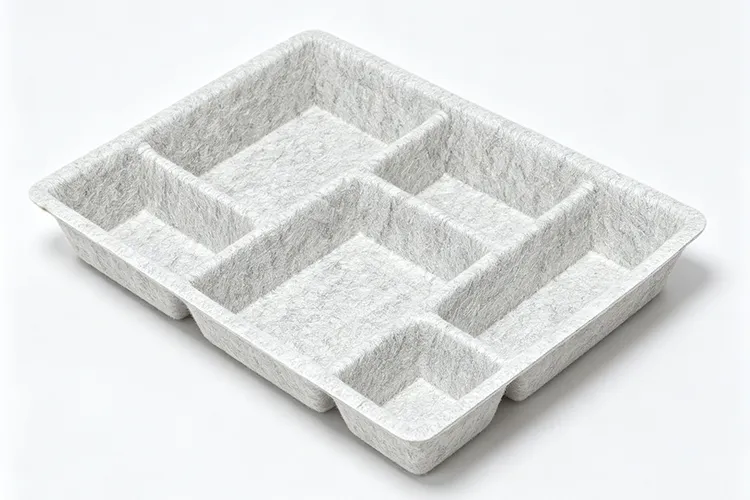
ألواح الخشب الطبيعي عالية الجودة مصنعي وموردي ألواح الخشب الطبيعي في الصين. نحن المنتج: الألواح الخشبية الصوتية ألواح الخشب الصوتي ألواح PET
تجنب تأخير الرد على استفسارك، يُرجى إدخال واتساب/سكايب الخاص بك مع الرسالة، حتى نتمكن من الاتصال بك في المرة الأولى.
سنرد عليك في غضون 24 ساعة. إذا كانت الحالة عاجلة، يُرجى إضافة واتساب/وي تشات: +86-13678899682 مباشرة.
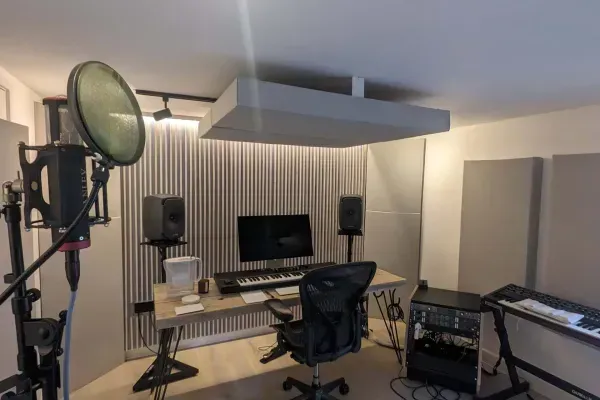
Home theater acoustic panels control early reflections and reverberation inside a small, enclosed room so dialogue stays intelligible and stereo imaging holds. Most rooms need absorption at first reflection points, diffusion or lighter treatment at the rear, and separate bass control that decorative panels alone cannot provide.
A home theater is usually a converted basement, spare bedroom, or bonus room. The dimensions are small, the surfaces are hard, and the listener sits close to the speakers. Three things go wrong at once.
Early reflections arrive from the side walls, ceiling, and floor within a few milliseconds of the direct sound. The ear does not hear them as separate events; it hears a smeared image and a dialogue track that sits slightly behind the picture. Reverberation builds because there is very little soft material in the room besides the seating. And low frequencies behave as room modes, producing seats where the bass is heavy and seats a metre away where it disappears.
الألواح الصوتية المزخرفة solve the first two problems well. They do not solve the third. This distinction matters commercially, because a residential client who buys a full wall of slat panels and still hears uneven bass will hold the supplier responsible. Set the expectation in the quotation, not in the complaint email.
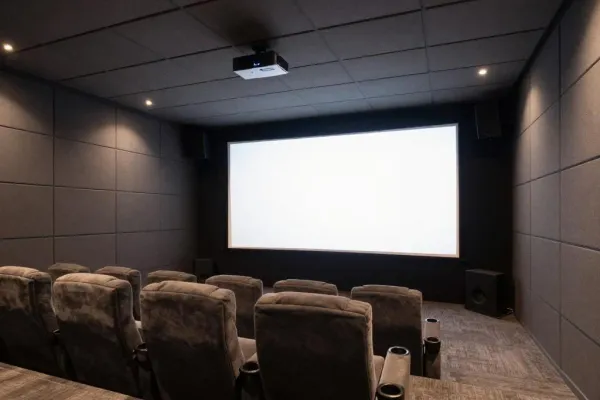
Panel quantity is not a percentage you guess. It comes from a placement map. Work through the room in this order:
An edge case worth flagging in every home theater quotation: the ceiling first-reflection point is often the single most audible one, and it is the point clients most often skip because they dislike the look of a ceiling panel. Wood slat panels running across the ceiling in line with the wall panels usually resolve the objection. Note the scope limitation in the certification section below before you promise a ceiling installation to a specifier.
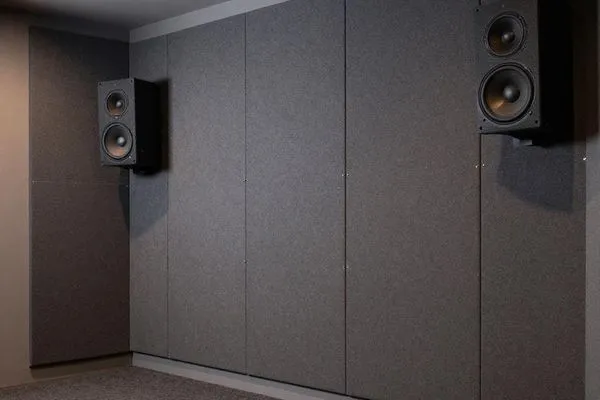
| Parameter | Documented Value |
| Profile Models | BN-01, BN-02, BN-03, BN-04, BN-05 |
| Standard Panel Sizes | 2400 × 605 mm, 2700 × 605 mm, 3000 × 605 mm |
| Panel Thickness | 18 mm or 21 mm |
| Slat Substrate | MDF, approximately 760–800 kg/m³ |
| Surface | Wood veneer or decorative surface; veneer thickness approximately 0.4–0.5 mm |
| Backing | In-house-produced polyester-fibre acoustic felt |
| Raw-Material Policy | E0-grade MDF |
| التطبيق | Wall and ceiling installation |
| Custom Options | Panel length, slat width, slat depth, slat spacing, veneer selection, and felt colour |
On acoustic data:. Any absorption number you have seen quoted for a slat panel of this construction elsewhere in the market belongs to a specific tested assembly with a specific slat spacing, felt density, and air gap. Transferring it to a different panel is not a specification, it is a guess. If a project requires stated absorption performance, request a sample test rather than accepting a catalogue figure from any supplier.
On weight: home theater installations frequently mount to plasterboard over stud, and installers need a per-panel weight to select fixings. Request it in writing at the quotation stage.
Three finish routes exist within the wood-look category, and they price and behave differently. Natural Wood Veneer panels (NBW series) use real veneer with natural grain variation. Technical Wood Veneer panels (TBW series, available in one-side or three-side veneer coverage) give repeatable grain across a large wall, which matters when a client is covering a full 4-metre screen wall and will notice colour drift between panels. PVC Surface panels (PBW series) trade the veneer look for a moisture-resistant, stain-resistant, wipe-clean face, which suits a basement theater with a wet-bar or a room where children handle the walls.
Yes, and it is the reason this category sells into premium residential at all. The grooves between slats accept a strip fixture, and the slats themselves become the diffuser. Documented parameters for the BEIEN LED strip accessory:
| Parameter | Documented Value |
| Colour Temperatures | 3000K, 4000K, 6000K |
| Power | 10 W per metre |
| Beam Angle | 120° |
| Luminous Efficiency | ≥35 lm |
| Colour Rendering Index | ≥80 |
| Ingress Protection | IP67 |
| الفولتية | 24 V |
| Lengths | 2400 mm, 3000 mm |
| Body | Flexible silicone with a matte finish |
| Included Accessories | Controller, 60 W or 150 W power supply, remote control, and 3 m extension cable |
The power supply selection follows directly from the run length. At 10 W per metre, a 60 W supply covers roughly 6 linear metres of strip and a 150 W supply roughly 15 metres, before you allow any headroom. Count the total metres of illuminated groove across all walls, not per wall, when the runs share a driver.
Now the part that competitor pages built around acoustics alone tend to miss: lighting a home theater is not the same as lighting a living room feature wall. Three practical constraints.
Light spilling onto the screen destroys contrast. Any strip on the front wall, in the same plane as the screen or forward of it, will wash the image during viewing. Either omit the front wall from the lighting run, or wire it to a separate channel that switches off independently.
Colour temperature interacts with perceived black level. 6000K reads clean in a showroom and cold behind a screen. For rooms where the lighting will stay on at low level during viewing, 3000K is the safer default, and the request for it needs to reach the factory at order stage because it is a build parameter, not a field adjustment.
The strips are dimmable through the supplied controller, but the controller and receiver need a physical location. Decide during layout whether that sits behind a removable panel section, in an adjacent cupboard, or in the rack. Retrofitting access into a finished slat wall means cutting a panel.
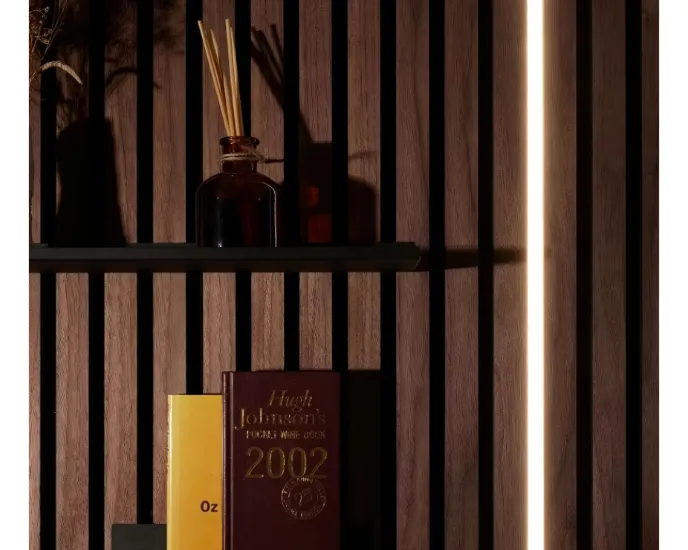
| Criterion | Wood Slat (BN / NBW / TBW) | PET Acoustic Panel Sheets | Fabric-Wrapped Absorbers (General Market Category) |
|---|---|---|---|
| Visual Result | Architectural slat lines with a veneer or PVC face | Flat felt surface with 40+ colour references (BP-01 to BP-54) | Flat fabric face; colour determined by textile choice |
| السُمك | 18 or 21 mm | 9, 12, 15 or 24 mm sheets | Typically 25–100 mm, depending on construction |
| Surface Behaviour | Slat relief provides both sound scattering and absorption | Flat absorptive face | Flat absorptive face |
| LED Groove Integration | Supported through the slat grooves | Not a groove-based format | Not standard |
| Cutting and Shaping | CNC cutting with a stated tolerance of ±0.3 mm | CNC-cut, engraved, shaped and perforated variants available | Site-fabricated or made to order |
| Published Fire Classification | See certification section; no wood slat assembly report is currently on file | EN 13501-1:2018 B-s2,d0 for the tested 9 mm sample only | Depends on supplier documentation |
| Best Fit in a Theater | Screen walls, side walls, ceiling runs and illuminated features | Rear-wall infill, ceiling clouds and colour-matched zones | Deep sound absorption where sufficient installation thickness is acceptable |
Compared with the flat foam and fabric-tile solutions that dominate the entry-level home theater market, أنظمة الشرائح give a client a finished architectural surface rather than a visible acoustic product, which is the whole basis of the premium residential proposition. The trade-off is real: a slat panel with an 18 mm profile will not deliver the low-mid absorption of a 100 mm fabric-wrapped absorber. Selling the slat wall as a complete acoustic solution for a critical-listening room overstates it.
Pricing is quotation-based. Panel type, dimensions, thickness, surface finish, fire-performance requirements, customisation level, packaging, order quantity, and shipping terms all move the figure, which is why a published price-per-panel from any supplier tends to describe a specification you did not want.
Minimum order quantity currently appears inconsistently across BEIEN’s own materials, with 50 panels stated on some pages and 100 panels on others. Confirm MOQ against the specific product family and finish before you commit to a client, and treat trial-order arrangements as a separate conversation.
Stated production lead time is approximately 7 to 15 working days depending on quantity and customisation, before shipping. Payment is normally T/T, commonly 30% deposit with the 70% balance before shipment. EXW, FOB, CIF, and DDP terms are available, with sea, air, and rail transport.
For a distributor building a home theater package, the practical order structure is a slat panel family in one or two veneer references, matching LED strips in a single colour temperature, and the drivers and controllers sized for the largest room you expect to sell. That keeps the accessory kit consistent across projects rather than re-specifying every quotation.
What is worth resolving next, before the first project ships: get the per-panel weight and a fixing recommendation for plasterboard substrates in writing, and decide whether the room needs a commissioned absorption test. Both are cheaper to settle at quotation stage than during a handover.
A: Quantity follows from the placement map, not from a room size formula. Mark the first reflection points on both side walls, the front wall, and the ceiling using the mirror method, treat those zones first, then decide how much of the remaining wall area is a finish decision rather than an acoustic one.
A: An 18 or 21 mm slat panel is not a bass treatment. Room modes need corner-loaded absorbers with far greater depth, which is a separate product category. Specify bass control independently.
A: BEIEN does not currently publish NRC or αw figures for the wood slat family. If a project requires a stated absorption value, request a test on the specific build-up rather than accepting a transferred figure.
A: The wood slat panels are stated as available for wall and ceiling application. Note that CE certificate DE/7552 describes a decorative wall covering, so ceiling scope under that certificate needs confirmation before it is cited to a specifier or building control body.
A: 3000K for rooms where lighting stays on at low level during viewing. 4000K and 6000K are available and read better in showrooms and multipurpose rooms. Colour temperature is set at order stage.
A: The strips ship with a controller, remote control, and a 60 W or 150 W power supply. Plan an accessible location for the controller and receiver during layout, because a finished slat wall does not offer easy retrofit access.
A: The available EN 13501-1:2018 classification of B-s2,d0 applies to one tested sample, a 9 mm polyester board, model BN-002, under SGS report SHFS2403000289FF. There is no current fire test report on file for the wood slat assembly.
A: BEIEN’s materials currently show both 50 panels and 100 panels depending on the page. Confirm the figure for the specific product family before committing to an end client.

 Arabic
  English
  French
  German
  Italian
  Spanish
  Russian
  Dutch
Dutch