High-Quality Natural Wood Panels Manufacturers and Suppliers In China. We product: Wood Acoustic Panels PET Panels
Avoid your inquiry is delay response, please enter your WhatsApp/Skype along with the message, so we can contact you at the very first time.
We will reply you within 24 hours. If for urgent case, please add WhatsApp/WeChat: +86-13678899682 directly.
A noisy cafeteria can make meal times stressful, tiring, and hard to manage. When voices bounce off hard surfaces, the room feels even louder. The solution is not guesswork. It is a clear acoustic plan that reduces reverberation and improves comfort.
To control the noise level in the school cafeteria, focus on sound absorption first. Add acoustic panels, ceiling baffles, sound-absorbing ceiling tiles, and other acoustical solutions on the ceiling and walls. Then improve layout, furniture, and staff routines so the room produces less echo and less overall noise.
Why is the cafeteria so loud in the first place?
What causes a high noise level in the cafeteria?
Should you soundproof a cafeteria or focus on acoustic treatment?
How does the ceiling affect cafeteria noise the most?
What acoustic panels work best for a school cafeteria?
Do wall panels, sound baffles, and ceiling tiles really help reduce noise?
How much panel coverage does a noisy cafeteria need?
What design and management changes help control noise levels?
What should schools and contractors look for in cafeteria acoustic materials?
Why do B2B buyers choose customized PET and wood acoustic panel solutions?
A cafeteria is loud because many sound sources happen at the same time. Students talk, chairs move, trays hit tables, doors open, and staff call instructions across the room. Then all of that sound reflects off hard surfaces like concrete, glass, tile, drywall, and metal. Instead of fading quickly, the sound keeps bouncing and building up. This repeated bouncing is called reverberation.
The problem is even worse in a school cafeteria because cafeterias are often large rooms with high ceilings, open floor plans, and many people eating at once. The Acoustical Society of America notes that school cafeterias are often much louder than adult cafeterias because they tend to have less effective sound absorption, more people, and higher seating density.
That is why many people ask why cafeterias are so loud. The answer is simple: the room is helping the noise grow. If you want real noise control, you need to change how the room handles sound waves, not just tell people to talk less.
A high noise level in the cafeteria usually comes from three things working together: too many hard reflective surfaces, too much activity in one open area, and too little sound absorption. The result is a noisy cafeteria where students and staff can’t hear clearly, and everyone starts talking louder just to be understood. That makes the room even louder.
Typical sound sources include:
When the sound waves hit a bare wall or ceiling, they reflect and reverberate. That echo and reverberation can increase stress levels, create disruption, and make conversations hard to follow. Extended exposure to loud sound can also matter for health. The CDC says exposure to loud sounds at or above 85 decibels over time can contribute to noise-induced hearing loss.
This is one of the most important questions in cafeteria soundproofing. Many people say they want to soundproof a cafeteria, but in most school projects, the first goal is not to block all sound from escaping. The first goal is to control the sound inside the room. That means reducing echo, lowering reverberation, and improving speech clarity.
In simple terms, soundproofing a cafeteria means building a stronger barrier so sound does not travel to other rooms. That may include heavier walls, special doors, soundproofing drywall, and sealed construction details. Acoustic treatment is different. It uses sound-absorbing materials to absorb sound inside the room so the level of noise feels lower and conversations become clearer.
For most cafeteria projects, acoustic treatment gives the fastest and most cost-effective result. If the biggest complaint is that the cafeteria itself is too loud, then sound absorption is usually the first fix. If the main problem is noise from escaping into classrooms or offices, then sound isolation details may need to be added later.
The ceiling often has the biggest effect on the noise level in your cafeteria because it is the largest open surface in the room. In many cafeterias, the floor is hard and easy to clean, the tables are hard, and the wall surfaces are durable but reflective. That means the ceiling becomes the best place to add large-area acoustical treatment without interrupting circulation or food service operations.
This is especially true in cafeterias with high ceilings or open ceilings. In those spaces, untreated sound can rise, reflect, and come back down into the room. That is why suspended sound baffles, acoustic clouds, or high-performance ceiling tiles are often used. These systems break up reflections and help absorb sound before it continues to bounce around the room.
A good ceiling strategy can include:
| Ceiling Strategy | What It Does | Best For |
|---|---|---|
| Acoustic ceiling tiles | Absorb sound across a large area | Standard drop ceilings |
| Hanging sound baffles | Reduce echo in tall spaces | Open ceilings, large halls |
| PET acoustic ceiling panels | Add sound absorption and design | Modern cafeterias |
| Wood slat acoustic ceiling systems | Improve sound quality and appearance | Premium public interiors |
If you only treat a small wall and ignore the ceiling, the cafeteria will still feel loud. In most cases, the ceiling and wall should work together.
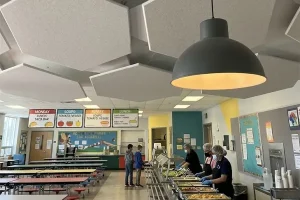
The best acoustic panels for a school cafeteria are panels that combine strong sound absorption, safety, durability, and design flexibility. In public-use interiors, that usually means durable PET felt panels, suspended baffles, or wood slat systems with acoustic backing rather than soft studio foam. BNPANEL’s guidance for commercial interiors explains that PET felt panels can be mounted on walls and ceilings or used as ceiling baffles to reduce noise levels and improve speech intelligibility.
For many projects, PET acoustic panels are a practical solution because they are lightweight, easy to fabricate, and suitable for wall or ceiling applications. If the space also needs a warmer and more decorative appearance, wood acoustic panels can help combine sound absorption and architectural finish in one system.
Some cafeterias need a more decorative look than plain felt boards. In those cases, PET acoustic panels with veneer finish or acoustic PET panels with wood texture finish can support both acoustic performance and project aesthetics. These products are especially useful when architects want the right balance between sound control and brand image.
Yes. They help because they do not try to stop every sound. They reduce the amount of sound that keeps reflecting in the room. That is the real reason acoustic treatment works in a loud cafeteria. Panels and baffles absorb sound, which lowers reverberation and makes the space easier to hear in.
Wall treatment matters because large wall surfaces can reflect a lot of energy back across the room. Ceiling treatment matters because it covers the largest open acoustic zone. Together, wall and ceiling systems produce stronger sound absorption and noise reduction than either one alone. This is why many acoustical solutions use a mix of ceiling and wall treatment rather than only one product type.
A practical layered plan may include:
The goal is not silence. The goal is to reduce cafeteria noise enough that meal times feel calmer and clearer for students and staff.
There is no one universal number because every cafeteria is different. The right amount of panel coverage depends on room size, ceiling height, table layout, wall or ceiling construction, and the existing noise level. A small cafeteria with standard ceiling tiles may need modest treatment. A large room with hard concrete, glass, and open structure may need a much larger amount of acoustic coverage.
In real projects, designers often start with the surfaces that reflect the most sound: the ceiling, upper wall surfaces, and large uninterrupted hard zones. The best plan usually targets the biggest reflection areas first, then adds secondary absorption where noise remains strong. That is why project-specific acoustic planning matters more than buying a random panel quantity.
A simple planning guide looks like this:
| Cafeteria Condition | Likely Acoustic Need |
|---|---|
| Low ceiling + basic tiles | Wall panels may add needed improvement |
| High ceilings + hard walls | Ceiling baffles plus wall panels |
| Open cafeteria with glass | Extra wall treatment and hanging absorption |
| Multi-use dining + assembly room | Broader ceiling coverage and zoning |
| Premium public project | Decorative PET + wood mixed system |
If you want a simple product explanation to share with specifiers, BNPANEL’s article What Is an Acoustic PET Panel? gives a clear introduction to how PET felt products work in schools, offices, and public interiors.
Material is the biggest part of the answer, but it is not the only one. Schools can also control noise levels by improving layout and daily management. If all the hard tables are grouped in one dense zone, the chatter will rise faster. If traffic paths cross serving lines and eating zones, the room becomes more chaotic. If meal times are too concentrated, the whole room becomes extremely loud in a short period.
Helpful non-material strategies include:
These ideas do not replace acoustical solutions, but they support them. The best results usually come when acoustic treatment and operating strategy work together. That is how schools can manage cafeteria conditions without turning the room into a space that feels dead or uncomfortable.
Schools, architects, and contractors should not choose a product only because it says “soundproof.” They should ask better questions. Does it really absorb sound? Is it suitable for a public food service environment? Is it easy to clean? Is it resistant to moisture? Does it support fire safety expectations? Can it fit the design concept and survive daily use?
Good cafeteria acoustic materials should offer:
real acoustic performance
visual quality for public interiors
durability in high-use spaces
easy installation and replacement
project-ready sizes and colors
appropriate safety and fire characteristics for the project
That matters for B2B buyers. Distributors need stable SKUs. Architects need finish options. Contractors need installation clarity. Brand owners need OEM/ODM flexibility. The right product is not just “acoustic.” It is project-ready.
This is where many global buyers become serious. They are not only asking how to fix a noisy cafeteria. They are asking how to fix it at scale, with the right finish, the right acoustic result, and the right supply partner. A school chain, public project contractor, or building-material distributor cannot work with random stock solutions that do not fit drawings or brand expectations.
As a professional manufacturer in China specializing in high-quality PET and wood acoustic panels, we support global B2B clients with customized wall and ceiling solutions. BNPANEL’s public information highlights in-house production, customization, and service for distributors, contractors, and brand companies, which matches what large project buyers usually need in real procurement.
For example, some projects may prefer the clean and flexible look of PET felt systems. Others may want the warmer look of wood slat panels. A mixed cafeteria and social zone may need both. A restaurant-style cafeteria inside a campus hub may benefit from ideas similar to BNPANEL’s own article on how to reduce restaurant noise with soundproof ceiling solutions and sound absorption, because the acoustic challenge is very similar: too many hard surfaces, too much reflection, and not enough sound absorption.

A school dining hall had high ceilings, hard wall surfaces, and strong lunch-period crowd noise. Staff said students have a hard time hearing one another, and cafeteria staff had to talk loudly to manage lines. The room was not unsafe, but it was tiring and disruptive.
Instead of doing a full rebuild, the project team upgraded the ceiling treatment and added wall-mounted acoustic panels in the most reflective zones. They also improved the queue layout and split the loudest seating zone into smaller sections. The result was not silence. It was clarity. People could still talk, but the harsh edge of the room dropped.
That is what a good cafeteria acoustic project should do. It should improve comfort, support communication, and make the room easier to use every day.
Why is the cafeteria so loud?
The cafeteria is loud because many people talk at once and sound reflects off hard surfaces like walls, floors, tables, and ceilings. This creates echo and reverberation, which makes the room feel even louder.
What is the best way to reduce noise in a school cafeteria?
The best way is to add sound absorption first. That usually means acoustic panels, ceiling baffles, and sound-absorbing ceiling treatments, then improving layout and operational flow.
Is soundproofing a cafeteria the same as acoustic treatment?
No. Soundproofing blocks sound from traveling to other spaces. Acoustic treatment controls sound inside the room by reducing reflections and improving clarity. In most cafeterias, sound absorption is the first need.
Do acoustic panels really work in cafeterias?
Yes. Acoustic panels work because they absorb sound and reduce reverberation. This lowers the harsh build-up of noise and improves speech intelligibility.
Are PET acoustic panels suitable for schools?
They can be a strong option for schools because PET acoustic panels are lightweight, design-flexible, and used on walls, ceilings, and baffle systems to reduce noise levels. Project suitability still depends on local code and specification requirements.
Can cafeteria noise affect health or learning?
High noise can increase fatigue, make communication harder, and raise stress. The CDC says extended exposure to loud sounds at or above 85 dB can contribute to hearing damage over time.
A cafeteria becomes loud because sound reflects off hard surfaces and builds up as reverberation.
The fastest way to control cafeteria noise is usually sound absorption, not full soundproof construction.
The ceiling often gives the biggest acoustic improvement because it covers the largest reflective area.
PET acoustic panels, wood acoustic panels, ceiling baffles, and sound-absorbing tiles can all help reduce cafeteria noise.
Wall and ceiling treatment should work together for better sound quality.
Good cafeteria acoustic design improves comfort for students and staff and makes communication easier.
Operational changes like traffic flow, lunch scheduling, and furniture details can support acoustic improvements.
B2B buyers should look for acoustic materials that combine sound absorption, durability, customization, and project-ready supply.

 English
  French
  German
  Italian
  Spanish
  Arabic
  Russian
  Dutch
Dutch