High-Quality Natural Wood Panels Manufacturers and Suppliers In China. We product: Wood Acoustic Panels PET Panels
Avoid your inquiry is delay response, please enter your WhatsApp/Skype along with the message, so we can contact you at the very first time.
We will reply you within 24 hours. If for urgent case, please add WhatsApp/WeChat: +86-13678899682 directly.
A room can look modern and still sound terrible. That is the problem many buyers face. They choose panels by color, price, or trend, then discover too much echo, weak design fit, or the wrong material for the job. The good news is that PET acoustic panels work very well—when you use them in the right way.
The disadvantages of PET acoustic panels are not deal-breakers, but they do matter. PET panels may offer less natural texture than wood, may need thicker designs for stronger low-frequency sound absorption, and may not suit every luxury interior style. Still, they remain one of the most practical acoustic panel options for modern commercial spaces because they balance sound control, customization, durability, and cost.

As a professional manufacturer in China specializing in high-quality PET and wood acoustic panels, we work with distributors, architects, contractors, and OEM/ODM buyers who ask a very practical question: Is PET the right acoustic material for this project? This article gives a clear answer. I will explain the real strengths, the real limitations, and how to choose PET acoustic panels more wisely for walls, ceilings, and large commercial spaces.
What are PET acoustic panels?
Why are PET acoustic panels so popular in modern interiors?
What are the main disadvantages of PET acoustic panels?
Do PET acoustic panels absorb enough sound for every space?
Are PET acoustic wall panels less decorative than wood panels?
How do PET acoustic panels compare with fiberglass, foam, and mineral wool?
Are PET panels durable enough for commercial wall panels and ceiling systems?
Where should you use PET acoustic panels, and where should you not?
How can architects and contractors reduce the disadvantages of PET panels?
How do you choose between PET acoustic panels and wood acoustic panels?
PET acoustic panels are sound absorbing panels made mainly from polyester fiber. In interior acoustic applications, the material is compressed into boards or shaped into decorative wall panels, ceiling baffles, suspended clouds, screens, and custom acoustic elements. These products are widely used to reduce echo, improve speech clarity, and make indoor spaces feel calmer and more comfortable.
A PET acoustic panel is valued because it is lightweight, easy to cut, easy to install, and highly adaptable in design. It can be used in offices, schools, meeting rooms, showrooms, hotel interiors, public halls, and many other commercial settings. Compared with some traditional acoustic materials, PET panels are cleaner to handle and easier to turn into decorative products.
For many B2B buyers, PET is attractive because it solves two problems at once: it helps with sound control, and it supports modern interior design. That is one reason PET acoustic wall panels have become such a strong category in today’s market.
You can see this direction in our own PET acoustic panels, where the focus is not only on performance, but also on color, shape, customization, and practical use in wall and ceiling systems.
PET acoustic panels are popular because they offer a rare mix of function and flexibility. Many acoustic products perform well in technical terms, but they do not always fit modern design language. PET panels are different. They can be clean, minimal, colorful, branded, and easy to customize for different interior styles.
Architects and designers like PET because the panels can be cut into many patterns and sizes. Contractors like them because they are lightweight and easier to install. Importers and distributors like them because they fit a wide range of projects, from simple office wall panels to more decorative custom systems. Brand owners also like them because PET products can support OEM and private-label development.
Another reason is versatility. PET panels can be used on walls, ceilings, workstations, partitions, and feature zones. They are not limited to one format. That flexibility helps buyers build full product lines instead of offering only one standard panel shape.
For commercial projects that need a clean and efficient acoustic solution, PET is often one of the easiest materials to specify. That is why it appears so often in modern acoustic wall and ceiling systems for offices, schools, studios, and public spaces.
Now let us get to the real issue. PET acoustic panels are useful, but they are not perfect. The first disadvantage is that they do not always deliver the same natural visual warmth as wood. In some premium interiors, PET may look more modern and practical, but less rich or luxurious than real wood acoustic panels.
The second disadvantage is acoustic depth. PET panels can absorb sound very well, especially mid and high frequencies, but not every PET product handles low-frequency noise equally well. In rooms with deeper reverberation problems, stronger bass build-up, or larger volumes, a thin panel may not be enough on its own. The answer is not “PET does not work.” The answer is “PET must be designed correctly.”
The third disadvantage is perception. Some buyers assume PET is only a budget product. That assumption is not always true, but it does affect how some markets position the material. If the finish, thickness, edge treatment, and installation design are too basic, the product may look too simple for high-end commercial interiors.
So the real limitations are usually not about failure. They are about fit:
That is why material selection should never be based on price alone.
Not every space. And that is important to say honestly.
PET acoustic panels are very effective in many interior environments, especially where speech control, echo reduction, and general sound comfort are the main goals. Offices, classrooms, meeting rooms, open workspaces, and reception areas often benefit greatly from PET wall and ceiling treatments. In these cases, PET can deliver strong practical results.
But some spaces need more than standard wall coverage. Large halls, music rooms, performance spaces, or areas with strong low-frequency sound may require a more complete acoustic strategy. In these cases, panel thickness, air gap, placement, and total coverage area matter a lot. A decorative PET panel alone may not solve every acoustic issue.
This is one of the biggest misunderstandings in the market. Buyers sometimes ask, “Is PET good or bad?” That is too simple. The better question is, “Is this PET panel design right for this room?” A thin panel in the wrong place may underperform. A thicker, well-placed PET system can perform very well.
So yes, PET absorbs enough sound for many commercial interiors. But no single panel is the answer for every acoustic problem.

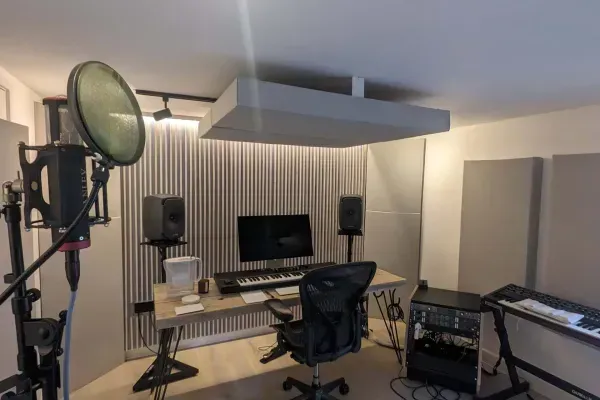
Acoustic panels placement in home theater ceiling and wall treatment
Sometimes yes. Sometimes no. It depends on the project style.
Wood acoustic panels usually bring a warmer and more premium visual effect. They are especially strong in luxury offices, hotel interiors, reception areas, conference halls, and feature walls where natural texture matters. Wood slat systems also create a strong architectural feeling that many designers prefer in upscale interiors.
PET acoustic wall panels, on the other hand, are more flexible in color, shape, and graphic styling. They can look minimal, youthful, creative, or highly customized. In modern workspaces, schools, co-working spaces, studios, and branded interiors, PET can actually feel more suitable than wood.
So if the question is, “Does PET look less premium than wood?” the honest answer is: in some projects, yes.
If the question is, “Is PET less decorative overall?” the answer is: not necessarily.
PET and wood simply create different design effects. That is why many professional buyers compare wood acoustic panels and PET panels together instead of treating one as always better than the other.
Compared with fiberglass and mineral wool, PET acoustic panels are usually cleaner, more decorative, and easier to convert into finished visible products. Fiberglass and mineral wool can be excellent acoustic core materials, especially in technical or hidden systems, but they often need fabric wrapping, framing, or additional finishing to look ready for interior use.
Compared with foam, PET panels usually offer a more professional and durable visual finish for commercial environments. Acoustic foam can be useful in some simple spaces, but it often lacks the design quality that architects and contractors want in finished public or office interiors.
This is why PET has become such a strong material in modern decorative acoustics. It may not replace every technical solution, but it often offers the best balance between:
From a manufacturing point of view, PET is also a strong material for OEM development. It can support many custom forms, colors, edge profiles, and application systems, which makes it practical for product line expansion.
In most commercial interior applications, yes. PET acoustic panels are generally durable enough for everyday wall and ceiling use when produced with the right density, finish quality, and installation method. They are lightweight, stable, and not difficult to maintain in normal indoor conditions.
That said, durability also depends on where and how the panels are used. In high-impact areas, poorly installed panels can still be damaged. In public spaces with very heavy wear, buyers should pay attention to panel thickness, edge construction, mounting method, and whether additional protective design is needed.
This is another reason why manufacturing quality matters. A PET panel should not be judged only by raw material name. Two products can both be called PET acoustic panels and still feel very different in rigidity, edge quality, finish consistency, and long-term use performance.
When clients ask us about durability, we usually guide them back to application. A well-made panel in the right indoor use case can serve very well for a long time. That is one reason durable custom acoustic panels are now common in long-life commercial interiors.
PET acoustic panels work especially well in:
These are spaces where speech clarity, echo control, visual neatness, and flexible installation all matter. PET is also a very good choice where color matching, custom shapes, and branding are important.
PET may be less ideal when a project requires:
This does not mean PET should be avoided in high-end projects. It means buyers should understand whether the project wants a warm natural finish or a modern engineered finish. Those are different design paths.
In many cases, the best result is not PET alone or wood alone. It is a smart combination of both.
The first step is proper panel selection. Choose the right thickness, format, and coverage area for the acoustic goal. A decorative thin panel may work well in a small meeting room, but a larger open office may need stronger ceiling treatment, baffles, or wider wall coverage.
The second step is smart placement. Good acoustic results are not only about material. They are also about location. If panels are placed where they can actually intercept reflected sound, the space will perform better. If panels are added only for decoration, performance may be weaker than expected.
The third step is design upgrade. Many of the visual disadvantages of PET can be reduced through better:
This is where manufacturing support becomes valuable. A supplier should not only sell a standard board. A good supplier should help buyers turn PET into a better architectural product. That is exactly why many clients work with our factory-direct acoustic panel manufacturing model for project-based customization.
Start with the project goal.
If the project needs flexible color, modern design, lightweight installation, and efficient sound control, PET acoustic panels are often the right choice. They are especially useful in offices, schools, studios, creative spaces, and branded interiors.
If the project needs a richer natural look, warmer texture, or a more premium architectural feeling, wood acoustic panels may be the better direction. They are often preferred in executive spaces, hotels, auditoriums, premium lobbies, and high-end feature walls.
A smart buyer will compare these questions:
If you answer those clearly, the material decision becomes much easier.
For many global B2B buyers, PET and wood are not competing enemies. They are two useful tools. The real job is choosing the right one for the right room. That is why many customers explore both our PET acoustic panel solutions, wood acoustic panel collections, and project case references before making a final decision.
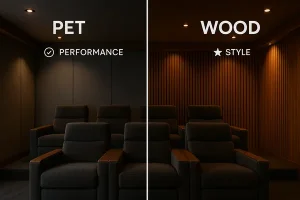
PET vs wood
| Item | PET Acoustic Panels | Wood Acoustic Panels |
|---|---|---|
| Visual style | Modern, clean, flexible | Warm, natural, premium |
| Color options | Very wide | More finish-based |
| Custom cutting | Easy | Also possible, but more finish-sensitive |
| Weight | Light | Usually heavier |
| Installation | Efficient | Depends on structure |
| Acoustic use | Strong for many commercial interiors | Strong when combined with acoustic backing |
| Best for | Offices, schools, studios, branded interiors | Hotels, feature walls, premium interiors |
| Main limitation | May feel less luxurious in some spaces | Usually higher cost and less color freedom |
Are PET acoustic panels good for commercial projects?
Yes. PET acoustic panels are a very practical choice for many commercial interiors because they combine sound absorption, flexible design, lightweight installation, and customization.
What are the disadvantages of PET acoustic panels?
The main disadvantages are that they may look less natural than wood in some premium interiors, may need stronger system design for deeper low-frequency control, and may appear too simple if the finish is basic.
Are PET acoustic panels better than wood acoustic panels?
Not always. PET and wood serve different design and project needs. PET is often better for flexible modern interiors, while wood is often better for warmer and more luxurious spaces.
Do PET acoustic panels last a long time?
In normal indoor commercial use, well-made PET acoustic panels can be durable and stable when the right product structure and installation method are used.
Can PET acoustic panels be customized?
Yes. One of PET’s biggest advantages is customization. It can support different sizes, colors, shapes, patterns, and branded solutions for B2B projects.
Should I choose PET panels for luxury interiors?
You can, but it depends on the design language. For some luxury interiors, wood may create a richer effect. For others, custom PET can still look advanced and architectural when designed well.
PET acoustic panels do have disadvantages. But most of those disadvantages are manageable when buyers understand the material clearly. PET is not a perfect solution for every space, and no honest manufacturer should say it is. Still, for many commercial projects, PET remains one of the smartest acoustic panel materials on the market.
It is lightweight. It is flexible. It is customizable. It is effective in many everyday acoustic applications. And when developed by the right supplier, it can become much more than a simple sound panel.
For distributors, architects, contractors, and OEM/ODM buyers, the key is not asking whether PET is good or bad. The key is asking whether this PET panel system is right for your project.
If your goal is to build practical, attractive, and scalable acoustic solutions, PET deserves serious consideration.
PET acoustic panels are highly practical for modern commercial interiors.
Their main disadvantages are visual warmth limits, project-fit limits, and low-frequency performance limits in some cases.
PET is not the best choice for every luxury or highly specialized acoustic space.
PET performs best when thickness, placement, and coverage are designed properly.
Wood acoustic panels may be better for warmer and more premium interiors.
PET panels are especially strong for offices, schools, studios, branded interiors, and custom B2B projects.
The best material choice depends on acoustic goal, style, and application—not just price.
A strong manufacturer can help reduce PET panel limitations through better customization and system design.

 English
  French
  German
  Italian
  Spanish
  Arabic
  Russian
  Dutch
Dutch